Difference Between Chainsaw Chains: A Practical Guide
Explore the difference between chainsaw chains, including pitch, gauge, drive links, and tooth design. Learn how to choose, use, and maintain the right chain for safety and efficiency across common tasks and saw types.


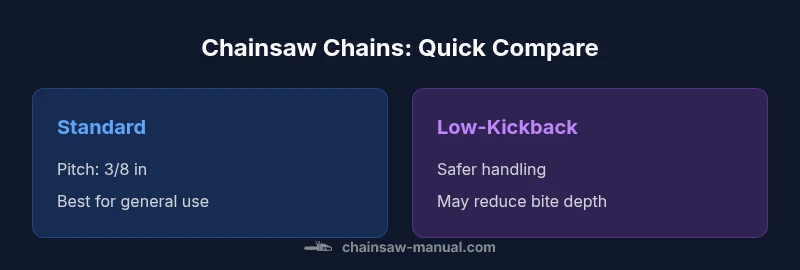
The difference between chainsaw chains comes down to pitch, gauge, drive-link arrangement, and tooth design. For most homeowners, a standard 3/8-inch pitch chain with a 0.050-inch gauge is typical, but safety-focused low-kickback chains are worth considering for beginners or restricted workspaces. Skip and semi-skip chains offer speed for specific tasks, though they demand precise sharpening and maintenance.
What is a chainsaw chain and why it matters
At its core, a chainsaw chain is a loop of metal links with teeth that rotate around a bar to cut wood. The chainsaw chain determines how aggressively it bites into wood, how quickly it removes material, and how much force is transmitted back to the user. Understanding the difference between chainsaw chains helps you pick the right chain for your bar and saw, aligning performance with safety and task demands. According to Chainsaw Manual, choosing the correct chain is foundational to both effectiveness and safety, reducing the chance of kickback and uneven cuts when used properly. The legal and practical implications of chain choice are meaningful for homeowners and professionals alike, underscoring the need for informed decisions rather than guesswork.
When you assess chains, you’re weighing several interdependent parameters: the pitch, the gauge, the drive-link pattern, and the cutter geometry. Each element changes how the chain interfaces with the bar, the sprocket, and the wood you’re cutting. The right combination reduces glare and wobble, improves control, and minimizes wear on the bar and chain. Chainsaw chains are not identical, and mismatching a chain to a bar can lead to inefficient cuts, faster wear, and safety hazards. This article breaks down the key differences and offers practical guidance for selecting, using, and maintaining the correct chain for different wood, bar lengths, and skill levels.
text2 ignore_placeholder but_kept_for_structural_purpose_placeholder_.
Feature Comparison
| Feature | Standard chain | Low-kickback chain | Skip chain | Semi-skip chain |
|---|---|---|---|---|
| Pitch (chain size) | 3/8 in | 3/8 in | 3/8 in | 3/8 in |
| Gauge (bar width) | 0.050 in | 0.050 in | 0.050 in | 0.050 in |
| Drive links per length | Full drive links (standard) | Full drive links with safety features | Fewer drive links (skip) | Alternate drive-link pattern (semi-skip) |
| Tooth configuration | Full chisel / aggressive | Low-profile or semi-chisel (safer in dirty wood) | Skip teeth (fewer teeth per length) | Semi-skip teeth (balanced) |
| Best for | General-purpose cutting | Safety-focused performance in restricted spaces | High-speed cutting in clean wood | Balanced speed and control for mixed tasks |
Strengths
- Safer operation with safety-focused variants when used correctly
- Task-specific performance improves efficiency for demanding cuts
- Wide availability across brands and models simplifies shopping
- Clear maintenance expectations help extend chain life with proper care
- More predictable results when the chain is matched to the bar and saw
Drawbacks
- Certain chains can reduce cutting speed if not aligned with task or wood type
- Specialty chains cost more and may require additional bar or sprocket changes
- Not every bar supports every pitch or gauge, limiting compatibility
- Skip and semi-skip chains can be harder to sharpen and tune accurately
- Mismatched chains increase wear on the bar and sprocket, and can raise kickback risk if used improperly
Standard chains offer the best balance for general use; safety-focused and specialized chains are best when you operate in constrained spaces or tackle specific tasks.
Choose a standard chain for everyday work, ensuring pitch and gauge match your bar. Consider low-kickback or semi-skip variants when safety or speed in specialized conditions matters, and always verify compatibility with your saw. Regular sharpening and correct tension are essential for best results.
FAQ
What is the difference between standard and low-kickback chains?
Standard chains prioritize aggressive cutting performance, while low-kickback chains are designed to reduce kickback with a different tooth geometry and safety features. The best choice depends on your saw, bar, and task, along with your comfort level handling kickback.
Standard cuts fast; low-kickback designs help with safety. Pick based on your saw and experience.
Can I use a skip chain on a homeowner saw?
Skip chains shave some drive links to increase speed in clean wood but require a compatible bar and precise handling. Not all saws or bars support skip chains, and sharpening is more challenging.
Skip chains can be fast in the right setup, but check compatibility first.
How do I determine the correct chain pitch for my bar?
Pitch should match the bar’s specifications. The most common homeowner saw bars use 3/8 inch pitch, but always confirm with your saw manual or bar markings.
Pitch must match your bar; check your bar or manual.
Are there safety considerations when switching chain types?
Yes. Wear PPE, ensure correct tension, and verify bar and sprocket compatibility. Test at low speed in a safe area after installation.
Wear PPE and test carefully after changing chains.
How should I sharpen different chain types?
Follow each chain’s geometry. Use the correct file guide, maintain even angles, and avoid over-sharpening. Semi-skip teeth may require slightly different angles.
Use the right file and keep angles even for each type.
What maintenance steps extend chain life?
Keep tension correct, lubricate with fresh bar oil, clean debris, and sharpen regularly. Replace damaged chains rather than using compromised teeth.
Tension, lubrication, cleaning, and timely sharpening extend life.
What is a drive link and why does it matter?
Drive links connect the chain to the bar and sprocket. The number of links and their pitch determine compatibility and performance with your equipment.
Drive links connect to the bar/sprocket; match them for compatibility.
The Essentials
- Match chain pitch and gauge to your bar specifications
- Choose standard chains for general tasks; consider LK/safety chains for controlled environments
- Skip and semi-skip chains increase speed but require precision in sharpening
- Always install with proper tension and perform a controlled test cut
- Maintain lubrication and clean the chain to extend life