Greenworks Chainsaw vs Stihl: A Practical Buying Guide
A thorough, evidence-based comparison of Greenworks electric vs Stihl gas chainsaws to help homeowners, DIYers, and pros choose the right tool for their yard and tasks in 2026.


TL;DR: For small-yard homeowners, Greenworks electric chainsaws offer quiet operation, easy maintenance, and lower upfront costs, while Stihl gas chainsaws deliver higher torque and longer runtime for demanding cuts. Your choice hinges on yard size, power needs, and how you balance convenience against performance. This comparison of greenworks chainsaw vs stihl helps you decide.
Core Differences in the Greenworks Chainsaw vs Stihl Decision
When you start evaluating the greenworks chainsaw vs stihl, the most fundamental split is power source. Greenworks chainsaws are predominantly electric, relying on battery packs or corded power. Stihl, meanwhile, is renowned for gas-powered models that deliver high torque and sustained performance under load. For homeowners and DIY enthusiasts, this isn’t just about peak power; it’s about reliability, maintenance, weight, and how you work. The Chainsaw Manual team emphasizes that choosing between these two families should reflect your yard size, typical tasks, and safety priorities. In practical terms, think long-term usability, not just a single cutting job. The emphasis here is practical guidance for real-world work scenarios rather than abstract specs.
Our analysis frames the greenworks chainsaw vs stihl decision around four pillars: power delivery, runtime and refueling, ergonomics, and total cost of ownership. You’ll see how battery energy density, engine design, and maintenance cycles influence every yard job—from pruning small branches to felling larger limbs. This section also foregrounds safety considerations and how each platform aligns with a safety-first approach.
According to Chainsaw Manual, the choice between Greenworks chainsaw vs Stihl should balance user needs, environmental considerations, and expected usage patterns. This means that even if one option appears technically superior on paper, real-world suitability may tilt in favor of the other. The remainder of this guide expands on these points with concrete scenarios and a clear decision framework.
Quick synthesis of safety-first considerations and practical usage scenarios to help you decide between electric and gas models.
Comparison
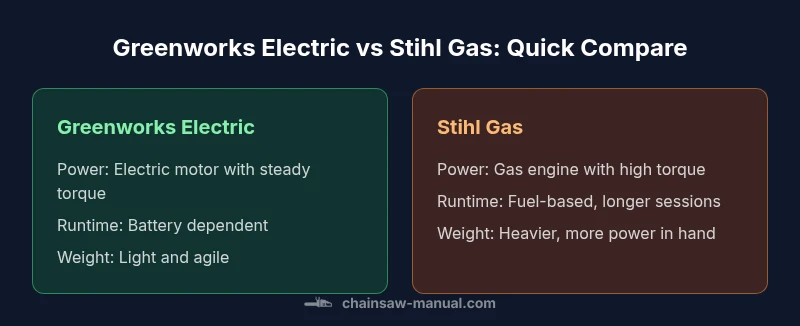
| Feature | Greenworks Electric Chainsaw | Stihl Gas Chainsaw |
|---|---|---|
| Power & Torque | Electric motor with steady torque suitable for light-to-moderate pruning | Gas engine with high torque for heavy-limb cuts and faster felling |
| Runtime & Refueling | Battery-dependent runtime; swap or recharge as needed | Fuel-based runtime with refueling pauses; longer sessions possible between fills |
| Weight & Handling | Typically lighter, easier to maneuver for beginners | Generally heavier, requires stronger handling and stance |
| Maintenance & Durability | Lower maintenance; battery care and occasional blade servicing | More maintenance tasks (fuel mix, air filter, spark plug, chain oil) |
| Noise & Vibration | Quieter operation, minimal vibration | Louder operation with noticeable vibration |
| Cost & Value | Lower upfront cost in many cases; cheaper operating costs over time | Higher upfront cost; ongoing fuel and maintenance costs |
| Best For | Small yards, pruning, apartment-friendly use | Professional or frequent heavy-duty cutting, larger properties |
Strengths
- Lower upfront cost for electric models
- Less ongoing maintenance; no fuel handling
- Quieter operation reduces nuisance and fatigue
- Easy to start and use for beginners
Drawbacks
- Limited runtime per battery charge for larger jobs
- Overall torque and continuous runtime can lag behind gas models
- Battery availability and charging time can create downtime
- Gas models may incur higher ongoing maintenance and fuel costs
Gas models generally excel for heavy-duty tasks and continuous runtime; electric chainsaws win for light-duty work, ease of use, and lower upfront costs.
Choose Stihl gas chainsaws if you need power, durability, and long continuous cutting sessions. Opt for Greenworks electric chainsaws for quiet operation, simplicity, and lower initial investment—especially on small lots and routine maintenance tasks.
FAQ
Is a Greenworks electric chainsaw enough for heavy, professional-grade cutting?
Electric models from Greenworks are well-suited for pruning and light-to-moderate cutting. For serious felling or continuous heavy-duty work, you’ll likely prefer a gas option like certain Stihl chainsaws. Always match model ratings to the job at hand and consider battery capacity.
Electric models work well for pruning and light cutting, but for heavy-duty jobs you’ll want gas. Make sure the model you choose fits the job.
Which is safer for beginners between Greenworks and Stihl?
Both brands emphasize safety features such as chain brakes, anti-kickback chains, and proper guards. Electric models can be more forgiving due to lighter weight and steadier power delivery, but all chainsaws require training, PPE, and proper technique.
Both are safe when used with training and PPE; beginners should start with lighter tasks and learn proper technique.
Do Greenworks batteries work across all Greenworks saws?
Battery packs are generally model-specific within the Greenworks ecosystem. You’ll gain convenience by choosing a system that aligns with your existing tools, but compatibility across brands or non-compatible models is limited.
Batteries usually stay within the same brand ecosystem, so pick a system that fits your tools.
Are Stihl gas saws more reliable in cold weather or damp conditions?
Gas-powered models tend to perform consistently in a wider range of conditions, including colder weather, but require proper cold-weather starting procedures and fuel care. Electric models may face battery performance drops in extreme cold.
Gas saws can handle cold near consistently; batteries may lose some capacity in very cold weather.
Can I switch from gas to electric in the middle of a project?
Switching mid-project is not practical because the tools have different power delivery and handling characteristics. It’s best to decide at the outset and use the tool that matches the task requirements.
It’s not practical to switch mid-job because the power, handling, and duration differ.
What maintenance does each require to stay safe and effective?
Gas saws require regular fuel/oil checks, spark plug changes, and air filter cleaning. Electric saws mainly require blade maintenance and battery care. Regardless of type, keep the chain sharp, tension correct, and perform regular safety checks.
Gas saws need fuel and filter upkeep; electric ones mostly need blade care and battery maintenance.
The Essentials
- Assess yard size to pick electric or gas first.
- Prioritize safety features and maintenance needs.
- Expect longer runtimes from gas models for heavy jobs.
- Consider total cost of ownership over time, not just upfront price.
- Battery availability can affect real-world usability in electric models.