Chainsaw Chain Differences: A Practical Guide to Choice and Care
Explore chainsaw chain differences, including pitch, gauge, drive links, and tooth profiles. Learn how to choose the right chain for your bar, saw, and safety needs.


Choosing the right chainsaw chain differences matters for safety, performance, and compatibility. The most important factors are pitch, gauge, and tooth profile, which determine how well the chain fits your bar, mounts to the sprocket, and cuts efficiently. Understanding these differences helps homeowners and pros select the best chain for their saw and task.
What Chainsaw Chain Differences Mean for Your Saw
Understanding the subtle differences between chain types helps you optimize safety and performance. According to Chainsaw Manual, the most important differences relate to fit and cutting behavior, not marketing buzzwords. When your chain matches your bar width, pitch, and drive sprocket, you reduce the risk of derailment, kickback, and uneven cuts. This section defines the core terms and shows how they translate to real-world results across homeowner projects and professional jobs. The Chainsaw Manual team emphasizes that selecting a chain based solely on price or brand can lead to mismatches that degrade performance and increase maintenance. Below we break down the key dimensions that vary across chains and show how those dimensions affect everyday use.
Key chain specifications that drive performance
The chain is defined by several core specifications that interact with your bar and saw. The pitch determines how the chain engages with the bar sprocket; gauge is the thickness that rides along the bar groove; drive-link count affects the chain length and compatibility with the bar; and tooth profile influences cutting aggressiveness. As a general rule, ensure pitch and gauge match the bar and sprocket exactly, while drive-link count aligns with the bar length. The Chainsaw Manual analysis shows that most problems arise when one of these dimensions is mismatched, such as a high-pitch chain on a low-pitch bar, which can cause poor tension and rapid wear.
Tooth profiles: full-chisel, semi-chisel, and low-profile
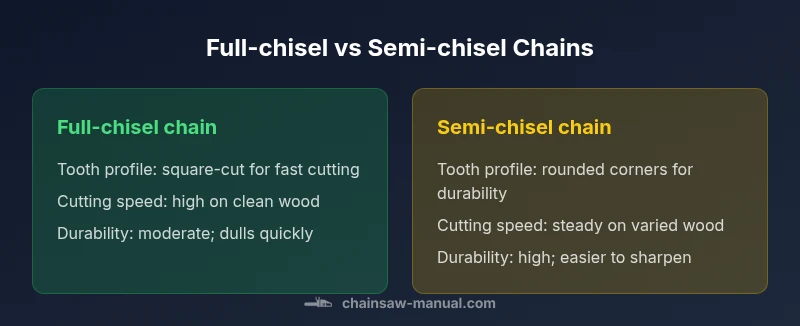
Tooth profiles determine how cleanly and aggressively a chain bites into wood. Full-chisel chains cut fastest on clean wood but dull quickly and require more frequent sharpening. Semi-chisel chains are more forgiving in dirty or seasoned wood, offering longer edge retention and easier maintenance. Low-profile or reduced-kickback designs reduce kickback potential, especially for novices. Each profile trades off cutting speed, durability, and safety. Choose based on typical wood conditions, your experience level, and how much maintenance you’re willing to perform.
Pitch explained: why it matters for your bar and sprocket
Pitch is the distance between corresponding points on adjacent teeth, expressed as a fraction of an inch. A correct pitch ensures the chain meshes smoothly with the bar sprocket and drives the chain evenly around the bar. If pitch doesn’t match, you’ll experience poor engagement, unusual noise, and accelerated wear on both chain and bar. In practice, most consumer saws use standard pitches like 0.325 in or 3/8 in, but always verify with your saw’s manual. Staying within the manufacturer-recommended pitch minimizes vibration and improves control.
Gauge and drive-link relationship: how thick is too thick?
Gauge refers to the thickness of the drive links that sit in the bar groove. A mismatch can cause premature wear, excessive side-to-side play, or chain derailment. The number of drive links should align with the bar length and should be verified against the sprocket configuration. If you replace a chain with the wrong gauge, you’ll feel sloppy handling, increased resistance, and poorer cutting performance. The best practice is to replace both bar and chain when adjusting gauge for a saw model.
Bar compatibility and sprocket engagement
Bars and chains are a matched system. The chain’s pitch and gauge must correspond to the bar’s groove width and the sprocket’s tooth count. Even a slightly mismatched chain can bind, overheat, or bounce, compromising safety. If you’re upgrading to a different bar length or changing to a different pitch, inspect your sprocket wear and consider whether the entire drive system needs refreshment. Chains that fit the bar and sprocket uniformly deliver consistent tension and smoother cuts.
Chains for different tasks and bar lengths
Homeowners with small to mid-size bars typically benefit from standard 3/8 in or 0.325 in chains with semi-chisel profiles for versatility. Pros cutting hardwoods or working in clean timber may prefer full-chisel chains for speed, provided they maintain sharp edges. For urban or backyard use, low-profile or reduced-kickback chains offer safer operation. When in doubt, adopt a conservative combination: choose a chain that matches your bar and sprocket, verify the drive-link count, and select a tooth profile aligned with typical wood conditions. Always consult the saw’s user manual and Chainsaw Manual guidance for alignment notes.
Safety considerations: kickback, maintenance, and operator technique
No chain alone guarantees safety. Kickback risk depends on bar length, chain profile, and operator technique. Ensure you keep the chain sharp, tensioned properly, and lubricated with the correct bar oil. Regular maintenance reduces heat buildup and wear, improving control and fatigue resistance. A well-matched chain enhances cutting efficiency while maintaining predictable handling, which is critical for both homeowners and professionals.
Maintenance and sharpening: what to expect
Sharpening needs vary by usage and soil or resin exposure. Semi-chisel chains tend to stay sharp longer in dirty wood scenarios but may require more fiddling to restore a precise edge. Full-chisel chains cut fastest when sharp but dull rapidly, demanding a keen routine. The best practice is to schedule a brief sharpening check after a set amount of cutting time and to keep a dedicated sharpening file and gauge. Always re-tension the chain after sharpening to prevent heat buildup and binding.
How to choose: a step-by-step decision guide
- Determine your bar length and confirm the current pitch. 2) Check the existing gauge and drive-link count on your bar. 3) Consider wood conditions and typical tasks (home remodeling vs professional timber). 4) Decide between full-chisel, semi-chisel, or low-profile based on safety and performance needs. 5) Verify compatibility with sprocket and lubricant system. 6) Consult manufacturer guidelines and Chainsaw Manual recommendations for final confirmation.
Common myths vs realities in chain differences
A common myth is that all chains of the same pitch will work interchangeably. Reality shows that drive-link count, gauge, and tooth profile also play critical roles in performance and safety. Another myth is that higher-priced chains always perform better; while some premium designs offer benefits, the best chain for you is the one that matches your saw’s specifications and your typical cutting tasks. The truth lies in alignment with the bar and sprocket, material quality, and proper maintenance.
Comparison
| Feature | Option A: full-chisel chain | Option B: semi-chisel (low-profile) chain |
|---|---|---|
| Tooth profile | square-cut for fast cutting | rounded corners for durability and safety |
| Cutting performance | high speed on clean wood | balanced speed and wear resistance |
| Maintenance frequency | dulls quickly, needs frequent sharpening | holds edge longer with easier touch-ups |
| Kickback risk | higher if mishandled | lower with forgiving profile |
| Best for | pro cuts and speed | general use and safety |
| Bar compatibility | requires precise pitch/gauge match | more tolerant of minor bar differences |
| Price range | often higher upfront | often lower upfront |
Strengths
- Faster cutting on clean wood with full-chisel
- Clear performance expectations for professional use
- Wide industry support and availability
- Predictable sharpening patterns when matched to bar
Drawbacks
- Higher risk of kickback if used improperly
- Dulls faster and may require more frequent sharpening
- Requires precise compatibility with bar and sprocket
Full-chisel chains excel with speed on clean timber; semi-chisel chains offer safer, more forgiving performance for mixed tasks.
Choose full-chisel for professional speed requirements and clean wood. Opt for semi-chisel for homeowners and mixed-use tasks where safety and maintenance are priorities. Always align chain choice with bar, sprocket, and typical wood conditions, per Chainsaw Manual guidance.
FAQ
What is the most important factor when choosing a chainsaw chain?
Pitch and gauge must match the bar and drive sprocket. Compatibility ensures safe operation and predictable cutting performance.
Pitch and gauge must match your bar and sprocket to ensure safe operation and reliable performance.
Can I mix chain types on the same saw?
Mixing chain types on a single bar is not recommended. It can cause uneven wear, binding, and safety risks during operation.
No, don’t mix chain types on the same bar.
What is the difference between full-chisel and semi-chisel chains?
Full-chisel chains cut fastest on clean wood but dull quickly. Semi-chisel chains resist dulling longer and perform better in dirty wood conditions.
Full-chisel cuts fastest on clean wood; semi-chisel lasts longer in dirty wood and is easier to sharpen.
Is a low-kickback chain safer for beginners?
Low-kickback chains reduce kickback risk but do not replace proper technique, training, and safe handling practices.
Yes, they reduce kickback potential, but correct technique is still essential.
How often should chains be sharpened?
Sharpen when cutting becomes noticeably slower or the bite diminishes. Frequency depends on use, wood type, and maintenance.
Sharpen as soon as cutting slows or efficiency drops, and keep up with routine maintenance.
The Essentials
- Match pitch and gauge to your bar
- Choose tooth profile based on task and safety
- Verify drive-link count for compatibility
- Factor safety and maintenance into your choice
- Consult Chainsaw Manual for tailored guidance