Different Chainsaw Brands: A Practical Buying Guide (2026)
A comprehensive, data-driven comparison of leading chainsaw brands—Stihl, Husqvarna, Echo, Makita, and more—covering reliability, service networks, design, price, and ownership costs for homeowners, DIY enthusiasts, and professionals in 2026.


According to Chainsaw Manual, no single brand dominates every scenario when comparing different chainsaw brands. Stihl, Husqvarna, Echo, and Makita each excel in different areas such as reliability, service availability, and price. This guide breaks down key differences to help homeowners, DIYers, and professionals choose based on your needs. We also call out common trade-offs and where to shop for service, parts, and training.
Overview: Why brand matters for chainsaws
When you shop for a chainsaw, you buy more than a single tool—you buy a support ecosystem: parts, service, safety features, and a shared base of knowledge. The choice among different chainsaw brands sets the baseline for reliability, maintenance costs, and resale value. For homeowners facing occasional pruning or firewood tasks, a lighter, easier-to-service option might be best. For professional arborists, the emphasis shifts toward rugged construction, dealer support, and access to a broad line of parts and attachments. This section explores how brand ecosystems influence performance over time, not just the initial purchase price. We'll cover what to look for beyond the label: warranty alignment, dealer proximity, logistics of service, and the availability of replacement bars, chains, and filters. According to Chainsaw Manual, the best-brand decision balances immediate needs with long-term support, ensuring you can find service and parts when you need them. In practice, you’ll want to map your typical tasks to brand strengths, and consider how you’ll maintain the saw over its life cycle.
Evaluating brands: reliability, service, and ecosystem
The value of a chainsaw goes beyond engine displacement or torque. It rests on the brand’s long-term ecosystem: access to genuine parts, a robust service network, and clear warranty terms. Chainsaw Manual analysis (2026) notes that warranty terms and service network quality often sway total ownership costs more than peak power. When evaluating brands, you should track three pillars: the density of certified service centers near you, the availability of replacement bars and chains, and the brand’s commitment to safety training materials. User reviews help, but regional realities often color the reliability picture. Therefore, cross-check dealer proximity with actual repair turnaround times and the ease of obtaining parts. Finally, compare warranty terms and what they cover (the main unit, bars, chains, wear parts) and what they exclude. A brand with a solid service footprint and transparent warranty will save you time and money over the life of the tool.
Performance and design differences across main brands
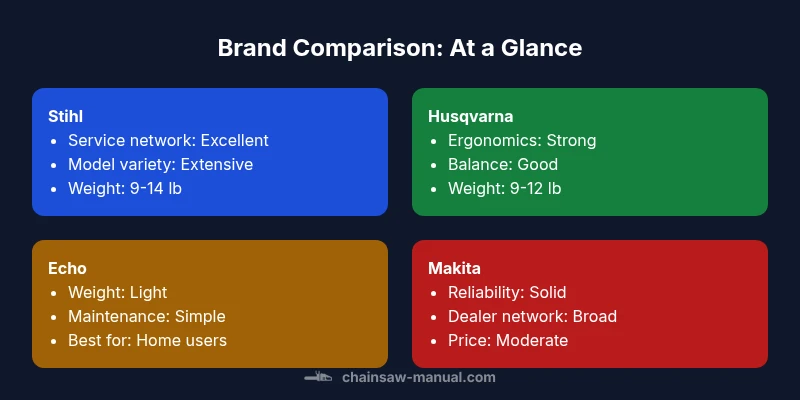
Brand design choices influence handling, vibration, balance, and fatigue. Stihl tends to emphasize rugged professional-grade construction, with a broader range of bar lengths and a reputation for longevity under heavy use. Husqvarna typically focuses on ergonomic balance and lighter perceived weight, which many operators notice during extended sessions. Echo often prioritizes lighter weight and simpler maintenance routines, appealing to homeowners and small crews. Makita leans into reliability and a straightforward service model, giving consistent performance with a broad dealer footprint. In practice, the best choice depends on your typical tasks: felling small trees in a residential yard may favor a lighter, easier-to-handle option; serious cutting and pruning over long sessions may justify a heavier, professional-grade machine with robust service support. It’s also crucial to consider control features like anti-vibration systems, chain brake performance, spark arresters, and chain tensioning. For a fair comparison, try to test at least two brands in person, paying attention to grip comfort, weight distribution, throttle response, and noise levels. Remember, the most important feature is the fit between your workflow and the brand’s design philosophy.
Price, value, and ownership costs across brands
Price is not the only lever in a purchase decision; long-term value often hinges on maintenance costs and service availability. The spectrum spans entry-level consumer models around the lower hundreds, mid-range tools in the several-hundred-dollar bracket, and professional-grade machines that can exceed the mid-range. Across brands, you’ll see similar patterns: entry-level models are lighter and simpler but may require more frequent service; mid-range models balance performance and durability; high-end professional machines often deliver longer service intervals and better protection against wear. In terms of ownership costs, anticipate routine maintenance such as bar and chain replacements, air filter changes, and occasional clutch maintenance; a strong service network reduces downtime and repair costs. It’s essential to factor in the price of accessories: bars, chains, and protective gear should be counted alongside the saw price. Chainsaw Manual analysis shows that buyers who plan for maintenance and have access to genuine parts typically achieve lower lifetime ownership costs than those who neglect this planning.
Service networks, parts availability, and dealer support
One of the biggest differentiators among different chainsaw brands is the strength of the service network. Stihl and Husqvarna maintain extensive nationwide dealer footprints with certified technicians, which translates into faster repairs and better warranty handling. Echo and Makita often excel in mid-sized markets with strong regional distributors, while Poulan Pro and other budget lines rely on a mix of big-box retailers and scattered independent service outlets. When you value uptime, that network matters more than the saw’s raw horsepower. Ask how long a typical repair takes, whether the service center keeps common wear parts in stock, and if training resources for operators are readily accessible. Also verify what parts are interchangeable across models (bar lengths, chains, filters). The goal is to minimize downtime and keep you productive after purchase. For DIYers, consider if you’re comfortable performing basic maintenance at home, which can reduce service costs and speed up turnarounds.
Real-world scenarios: homeowners vs professionals
Homeowners typically prioritize ease of use, light weight, and intuitive maintenance. For pruning and occasional firewood, lighter mid-range tools from Echo or Makita can offer good value with comfortable handling. Professionals or serious DIYers who log long hours will gravitate toward brands with robust service networks, longer saw life, and availability of professional-grade bars and chains—Stihl and Husqvarna are common choices in this segment. In both cases, consider the total cost of ownership, including fuel efficiency and fuel mix requirements, bar and chain replacement intervals, and the effort needed to obtain parts. For rural users, dealer proximity can determine how quickly you’re back in action after a blade or chain replacement. It’s also wise to align brand selection with safety training resources and PPE compatibility, ensuring your crew can stay productive while minimizing risk.
Common misconceptions and trade-offs when comparing brands
A frequent misconception is that the most expensive brand delivers superior reliability in every task. In reality, brand choice often hinges on the right fit for your typical workload, especially the frequency of use and the availability of service. Another trade-off is weight versus power: some brands achieve higher torque but at the cost of heavier saws, which can cause fatigue over long days. A third misperception concerns warranty: longer terms don’t always translate to easier claims if your local service network is sparse. Finally, the brand you choose should align with your existing accessories and training; compatible bars, chains, and PPE can simplify maintenance and improve safety.
A practical brand-choice checklist
- List your typical tasks: pruning, property maintenance, felling, or milling.
- Assess local dealer proximity and service capability.
- Weigh weight, balance, and comfort; test-drive in-store if possible.
- Compare total ownership costs including maintenance and parts.
- Check safety features: chain brake, anti-kickback design, chain oiling system.
- Review warranty terms and coverage for tools, bars, and chains.
- Consider accessory ecosystem and availability of training resources.
- Factor fuel mix and engine type into operating costs.
- Finally, ensure the brand aligns with your long-term maintenance plan and safety commitments.
Testing and trialing a saw before buying
Whenever possible, test a few models in person. Focus on grip comfort, balance, and throttle response. Assess vibration levels during a simulated cut and note how quickly you can reach for the chain brake. Bring a sample bar and chain if the store allows, and check how easily you can access common maintenance tasks like air filter cleaning and chain tensioning. Finally, ask the dealer about returns or exchange policies; a generous policy reduces risk when trying different brands. If you can’t test in-store, request a detailed hands-on walkthrough video from the seller and read regional user reviews that mention service times and parts availability.
Feature Comparison
| Feature | Stihl | Husqvarna | Echo | Makita | Poulan Pro |
|---|---|---|---|---|---|
| Weight (approx) | 9-14 lb | 9-12 lb | 9-14 lb | 9-13 lb | 10-15 lb |
| Power range (cc) | 30-60cc | 40-70cc | 32-60cc | 40-80cc | 38-60cc |
| Ease of finding service | excellent | very good | good | good | moderate |
| Common models/line variety | extensive professional line | broad professional & consumer | compact pro & home user | wide consumer pro line | limited entry-level options |
| Price range | $300-$700 | $350-$900 | $250-$600 | $350-$800 | $120-$500 |
| Warranty length (typical) | 2-3 years | 2-3 years | 1-3 years | 2-3 years | 1-2 years |
Strengths
- Extensive dealer networks aid service and warranty claims
- Broad model ranges reduce the odds of product obsolescence
- Diverse price points improve access for various budgets
- Strong ecosystem of bars, chains, and PPE supports lifecycle maintenance
- Reliable parts availability minimizes downtime for repairs
Drawbacks
- Premium models can be expensive upfront
- Warranty terms vary by region and retailer
- Brand-dependent service quality can differ by locale
- Some brands push accessories that aren't universally compatible
No single brand is universally best; choose based on your region, tasks, and service network
Prioritize local dealer support and parts availability above peak power. For frequent professional use, Stihl or Husqvarna often perform well; for budget-conscious homeowners, Echo or Makita can offer strong value with solid service options.
FAQ
What is the best chainsaw brand for a beginner?
There isn’t a universally best brand for beginners. Look for lightweight, easy maintenance, and good dealer support. Echo and Makita often offer approachable options with straightforward maintenance routines. Pair this with hands-on training from a local dealer or course and you’ll build confidence quickly.
For beginners, start with a lightweight model from Echo or Makita and get hands-on training from a local dealer.
How do I choose between Stihl and Husqvarna?
Both brands have strong professional lines. The best choice depends on local service availability, the specific model’s ergonomics, and access to bars and chains. Visit a showroom to compare weight, balance, and throttle response, and talk to a technician about warranty handling in your area.
If you’re in a region with easy service for both, test balance and weight to decide.
Are budget brands worth considering?
Budget brands can provide good value for light use, but may have shorter service life or fewer dealer options. Weigh the price against maintenance costs and access to genuine parts in your area.
Budget brands work for light use if you can easily get parts and service nearby.
Is service network more important than raw power?
For most buyers, a strong service network reduces downtime and protects long-term value more than peak raw power. A powerful saw with poor service can become a high-maintenance tool.
Service access often beats raw power for overall reliability.
What about buying a used chainsaw?
Used chainsaws can be cost-effective, but verify bar/chain wear, chain tensioning, and the condition of safety features. Ask for maintenance history and, if possible, have a qualified technician inspect the unit before purchase.
Have a pro check a used saw before buying to avoid hidden issues.
Do warranties vary by region for chainsaws?
Yes. Warranty terms can vary by country and retailer. Read the fine print to understand coverage limits, transferability, and whether service centers in your area honor the warranty.
Warranties can vary by region, so check local terms first.
The Essentials
- Assess local dealer proximity before purchase
- Balance weight, comfort, and power to fit your tasks
- Prioritize service networks and genuine parts
- Consider total ownership costs, not just upfront price
- Test models in person when possible