What Angle Chainsaw Sharpening Means for Safe, Efficient Cutting
Discover the optimal sharpening angle for your chainsaw chain. This guide explains how angle affects bite, durability, and cutting performance, plus practical steps to set and maintain the correct angle safely.


In chainsaw sharpening, the angle you use on each tooth is the key to performance. For many standard chains, a sharpening angle in the mid-20s to mid-30s degrees range provides a healthy balance between bite and edge life. The exact angle depends on chain type, guide rail, and wood density, but consistency matters more than chasing a perfect number. According to Chainsaw Manual, sticking to a uniform angle across all teeth is essential for predictable cutting.
What the sharpening angle really is and why it matters
In the world of chainsaw maintenance, the sharpening angle is the slope registered on each tooth during filing or grinding. It determines how aggressively the tooth bites into wood and how long the edge stays sharp under load. A common starting point for many homeowners is a mid-20s to mid-30s degree range, but the exact number depends on chain type, tooth shape, and the wood you typically cut. The crucial point is consistency: if every tooth is ground to the same angle, you’ll observe steadier cutting behavior, fewer snags, and a more predictable bite. According to Chainsaw Manual, even small deviations from the intended angle accumulate across teeth, leading to uneven wear and reduced performance over time. When you approach sharpening with a clear angle target and a reliable gauge, you’ll spend less time chasing dull edges and more time making progress on your project.
Why the angle choice profoundly affects performance and safety
The angle determines how much surface contact each tooth makes with the wood, which in turn controls bite, kickback tendency, and chain life. A too-narrow angle can dull quickly and leave a tooth with insufficient edge height to engage the wood, causing rubbing and slower cuts. Conversely, an overly steep angle can cut aggressively but wear edges faster and increase the risk of kickback under high load. Maintaining a balanced angle across teeth minimizes uneven wear and ensures smoother operation. In practice, homeowners and professionals often find that a steady angle—within a recommended range—outperforms chasing a single, “perfect” degree. The Chainsaw Manual team notes that the benefits are systemic: you’ll notice steadier kerf formation, improved feed rate, and more consistent results on both softwood and hardwood.
How to determine the correct sharpening angle for your chain: a practical framework
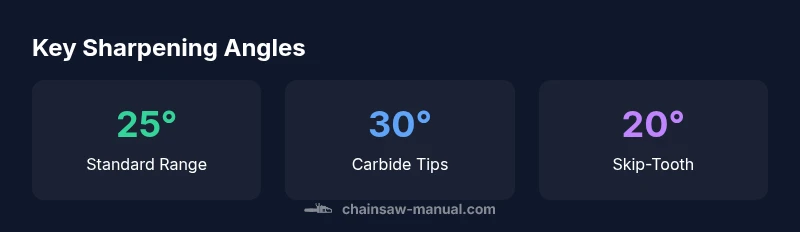
Start with your chain type and manufacturer recommendations, then use a file or stone gauge to set a baseline angle. If you’re unsure, begin with a conservative middle angle, such as 25–30 degrees for standard chains, and adjust based on performance. Use the same angle for every tooth, including tie straps and rakers where applicable. Check your work after a few strokes by eye and with a gauge: the edge should be uniform along the entire length of each tooth. For the Chainsaw Manual community, the emphasis is on repeatability and safe operation. If you work with different wood densities, you may need to adjust by a few degrees but preserve cross-tooth consistency. Finally, verify that your guide bar and chain are compatible with the sharpening method you employ (file, grinder, or guided jig).
Sharpening angle ranges by chain type
| Model Type | Typical Angle Range | Notes |
|---|---|---|
| Standard chain | 25–30 degrees | Balanced bite and longevity |
| Carbide-tipped chain | 30–35 degrees | Durable edge life, slower wear |
| Skip-tooth chain | 20–25 degrees | Faster cutting with fewer teeth engaged |
FAQ
What is the recommended sharpening angle for most chainsaw chains?
Most standard chains perform well with an angle in the mid-20s to mid-30s degrees range. Start with 25–30 degrees and adjust based on cutting feel and wood type. Always ensure all teeth share the same angle for uniform wear.
For most chains, aim for about 25 to 30 degrees and keep every tooth at the same angle.
Can sharpening angles differ between chain types like standard versus carbide-tipped?
Yes. Carbide-tipped chains often tolerate a slightly steeper angle (30–35 degrees) due to the different edge geometry and durability. However, stay within manufacturer recommendations and maintain consistency across all teeth.
Carbide-tipped chains usually use 30 to 35 degrees, but always follow your chain’s guidance.
Is it safe to sharpen by eye if I don’t have a gauge?
Sharpening by eye can introduce inconsistent angles. If you don’t have a gauge, practice on an old tooth to set a reference, then use a file with steady pressure and check for uniform edge height across teeth. Prefer using a proper gauge for best results.
It’s better to use a gauge, but if you must, reference a familiar angle and be consistent.
How do I know if my chain angle is off after sharpening?
Look for a visibly uneven edge height along teeth, unequal bite, or a ragged kerf when cutting. If cutting feels chattery or you notice drift, re-check all teeth for uniform angle and edge height using a gauge.
If the cut isn’t smooth or you feel uneven bite, re-check the angles on all teeth.
What tools do I need to achieve a precise sharpening angle?
A flat file or file guide, a sharpening jig or gauge, safety PPE, and optionally a grinder with a proper guide. Always work on a stable surface and secure the bar before starting.
Get a sharpening gauge or jig, plus your file, for precise angles and safer sharpening.
“A consistent sharpening angle is the foundation of predictable chain performance; small variances across teeth compound under load.”
The Essentials
- Follow a consistent sharpening angle across all teeth
- Start with 25–30° for standard chains and adjust based on performance
- Use proper gauges/tools to maintain accuracy
- Balance bite with edge life to optimize cutting efficiency
- Always verify tool compatibility before sharpening