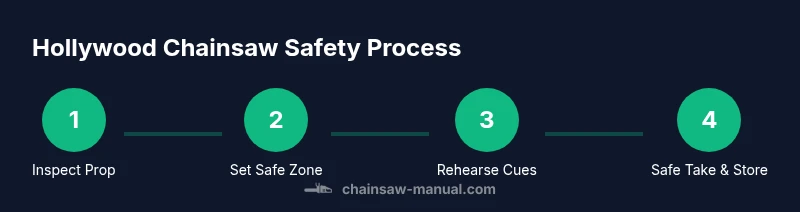
Hollywood Chainsaw Safety: A Practical Filmmaking Guide
A comprehensive, safety-first guide for using Hollywood chainsaw props on set, covering prop choices, PPE, planning, and step-by-step handling to protect cast and crew.


Learn to safely use a Hollywood chainsaw prop on set, with clear safety steps, PPE requirements, and scene planning to minimize risk. This guide covers prop verification, proper handling, and crew communication so actors and crew stay protected. Always follow Chainsaw Manual safety standards on every production, for example during pre-production planning and wrap-out debriefs.
What is a Hollywood chainsaw?
A Hollywood chainsaw refers to a prop used on film and TV sets to simulate cutting action without a live engine. On set, props range from inert training models to fully frangible units designed to look real while remaining safe when handled by actors and crew. According to Chainsaw Manual, safety starts with clearly distinguishing a working saw from a cinematic prop, and with a pre-production plan that defines grip, stance, and distance from the camera and talent. When used correctly, a Hollywood chainsaw can contribute to authentic action without risking fingers or crew. The goal is visual realism with predictable safety controls: deactivated power, guarded blades, and well-communicated cues. Productions should document who is authorized to handle the prop, where it can be touched, and how close the camera and cast will be to the action. These decisions set the foundation for all subsequent planning and rehearsals. The Chainsaw Manual team emphasizes that planning, training, and constant communication are the best defense against on-set accidents.
Film props vs real chainsaws: safety distinctions
The safety profile of a Hollywood chainsaw depends on the prop’s design and how closely it is controlled on set. Real chainsaws carry power, inertia, and moving parts that require strict licensing and training; cinematic props rely on inert mechanisms, non-functional blades, and safety interlocks. Chainsaw Manual analysis shows that for film productions, the risk is dramatically lowered when the prop is inert, clearly marked as deactivated, and never connected to any power source during shoots. Visual realism must be balanced with predictable safety controls, and every scene should include a clear boundary between actors and edges of any simulated cutting action. In practice, this means using a prop that cannot start accidentally, with guards in place, and with a dedicated safety lead who monitors actions in real time.
PPE and safe handling for film sets
Personal protective equipment (PPE) is a non-negotiable layer of safety when working around Hollywood chainsaws. At minimum, performers and crew should wear a hard hat with a face shield, hearing protection, cut-resistant gloves, long sleeves, and sturdy footwear. Prolonged wear should be facilitated with breaks to prevent fatigue, which can compromise judgment. In addition to PPE, there should be clear role assignments, with a safety lead responsible for verifying prop deactivation, gatekeeping the rehearsal zone, and supervising any interaction with the prop. Chainsaw Manual emphasizes training and refreshers for all personnel, including how to communicate cues, when to pause, and how to report concerns before filming begins.
Prop verification and deactivation steps
Before any filming, the prop must be visually inspected and physically verified as deactivated. Check that the blade is guarded, the bar is secured, and the chain cannot move. Remove any power source or attempt to connect to one, even inadvertently. Maintain a log of prop status, with signatures from the safety lead and camera operator. A secondary check should occur immediately prior to each take. A strictly enforced rule is that only the designated operator touches the prop during takes, and never while the camera or lights are active in the shot.
Setting up the shot safely
Careful scene planning reduces risk and increases believability. Establish a clearly defined safety zone around the action, using barriers and seating to keep non-essential personnel at a safe distance. Camera angles and blocking should be choreographed to keep hands and prop out of frame in ways that still read as authentic. If stunts appear risky, substitute with a shorter blade, a non-cutting animation, or a post-produced effect. A pre-shot briefing should confirm where actors stand, where the prop is placed, and how cues will be signaled from the director and safety lead.
Operating with a deactivated prop: rules and cautions
Operate the Hollywood chainsaw prop only in controlled, rehearsed sequences. Do not swing, strike, or move the prop toward anyone unless the shoot calls for it in a designed, choreographed way. Maintain constant communication between actor, safety lead, and camera crew. If anything feels off—unusual noise, loose parts, or a new obstacle—pause the scene and re-check the prop and zone before continuing. Remember that the goal is safe realism, not risky spectacle.
Rehearsals, communication, and signals
Rehearsals should center on timing, distance, and headspace: actors should know when to react, when to stop, and how to signal discomfort or error. Use clear, universal cues (hand signals or a compact clicker) to replace spoken instructions during takes. The safety lead should coordinate with the director and DP to ensure all actions are within the planned safety margins. Communication at every stage is essential to preventing mishaps and ensuring the final shot looks convincing without compromising safety.
Cleanup, storage, and post-shoot checks
After filming, inspect the prop again for any damage and document its status. Store the inert prop in a secure area, away from heat, moisture, and potential impacts. Debrief with the crew to discuss what worked, what didn’t, and any safety concerns that arose. A brief post-shoot checklist helps maintain accountability for the Hollywood chainsaw prop and reinforces safety culture for future productions.
Tools & Materials
- Prop chainsaw (deactivated)(Non-functional model with blade guard and safe cut design)
- Personal protective equipment (PPE) kit(Helmet with face shield, ear protection, cut-resistant gloves, long sleeves, sturdy boots)
- First aid kit(Includes CPR mask and wound care supplies)
- Gaffer tape and marking cones(For zone demarcation and quick fixes on set)
- Fire extinguisher(Recommended for any set with potential heat or sparks)
Steps
Estimated time: 25-35 minutes
- 1
Inspect prop and deactivate
Check the prop for any functional parts and confirm the blade guard is in place. Remove or disable any power source and verify there is no possibility of motion. Document deactivation in the safety log.
Tip: Always confirm deactivation status with the safety lead before rehearsals. - 2
Establish a safe filming zone
Define a clear boundary that keeps cast, crew, and camera within safe distances. Place barriers or markers and brief everyone on the zone. Ensure only essential personnel are inside the risk area during takes.
Tip: Rehearse the zone setup with a walkthrough—walk the perimeter as if you’re in the shot. - 3
Prepare actor grip and stance
Demonstrate a controlled grip and a balanced stance away from others. The actor should maintain consistent distance from the prop and camera, avoiding sudden swings or jerky motions.
Tip: Use a mirror or monitor to verify arm extension and body alignment before action. - 4
Coordinate with camera and crew
Establish hand signals or a clicker cue to replace verbal directions during takes. The safety lead should coordinate with DP to ensure the shot stays within planned safety margins.
Tip: Do a quick rehearsal with all departments to confirm timing and visibility. - 5
Execute the take with safeguards
Perform the action exactly as rehearsed, maintaining the boundary and avoiding contact with people. If anything feels off, pause immediately and reassess.
Tip: Stop at the first sign of discomfort or prop misalignment. - 6
Wrap and store prop
Disassemble the shot, secure the prop, and return it to a locked storage area. Complete a quick debrief and log any issues for future shoots.
Tip: Record prop status and location to prevent accidental reuse without re-check.
FAQ
Is it safe to use a real chainsaw as a prop?
No. Real chainsaws pose significant danger on set. Always use deactivated prop models or fully simulated blades with strict guard systems. Follow established safety protocols and local regulations.
No. Real chainsaws are too dangerous for on-set use. Always opt for deactivated props and follow safety protocols.
What PPE is essential around Hollywood chainsaw props?
At minimum, wear a helmet with face shield, hearing protection, cut-resistant gloves, long sleeves, and sturdy boots. Additional protection like chainmail or arm guards improves safety for dynamic scenes.
Wear a helmet with face shield, ear protection, cut-resistant gloves, long sleeves, and sturdy boots. Add extra protection as needed.
How should prop deactivation be documented?
Log prop deactivation status in a shared production sheet before rehearsal, before each take, and after wrap. Include signatures from the safety lead and the camera operator.
Keep a running log of prop deactivation with signatures from key safety and camera staff.
Can stunts be performed with a Hollywood chainsaw prop?
Stunts should be designed to avoid contact with the prop or people. If motion is required, choreograph it with clear safety boundaries and use alternate effects to simulate action.
Only choreographed stunts with strict safety boundaries, or use alternative effects to simulate action.
What should I do if something feels unsafe?
Pause the take immediately, assess the situation, and re-check the prop and zone before continuing. Safety comes first, even if it delays shooting.
If anything feels unsafe, stop now, assess, and fix before proceeding.
Are there legal considerations for prop use on set?
Check local regulations and union guidelines for prop usage, especially around weapon-like props. Ensure all safety standards are documented and communicated to cast and crew.
Follow local laws and union guidelines; document and communicate safety standards clearly.
Watch Video
The Essentials
- Use inert props over live equipment whenever possible
- Wear full PPE and enforce zone boundaries at all times
- Document prop status and rehearse safety cues meticulously
- Prioritize safety culture as a non-negotiable on set