Do You Need a License to Use a Chainsaw in the UK? A Practical Guide
Explore whether a UK license is required to operate a chainsaw, when training is essential, and how to stay compliant and safe. Chainsaw Manual details legal basics, training routes, and best practices for homeowners and professionals.


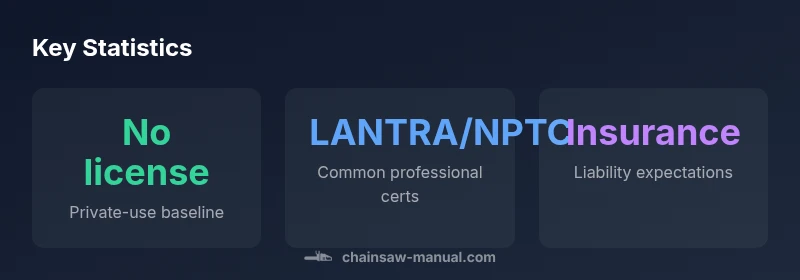
In the UK, you do not need a general license to own or use a chainsaw for private, non-commercial tasks. For professional work, employers typically require proof of competence through recognized training (LANTRA, NPTC/City & Guilds). Always follow local rules and wear proper PPE; this guide outlines rights, duties, and training paths.
Legal baseline for UK chainsaw use
In the UK, there is no general license required to own or operate a chainsaw for private, non-commercial tasks. The legal framework centers on safety responsibilities rather than a single permit. According to Chainsaw Manual, the distinction between licensing and competence matters; regulatory emphasis falls on risk assessment, training, supervision, and PPE. For paid work, employers almost always expect demonstrable competence through recognized training and certification; private landowners who hire contractors still benefit from ensuring those contractors hold appropriate qualifications and insurance. The Health and Safety at Work Act, the Management of Health and Safety at Work Regulations, and related guidance require workplaces to assess risks, provide training, and supervise operations. When work involves public land, trees near highways, or formal contracts, local authorities may impose specific requirements or demand evidence of competence before work can begin. The result is a practical standard: you don't need a national license to use a chainsaw in everyday home jobs, but you do need to prove you can do so safely and legally when money changes hands or public risk exists. If you are unsure about your exact situation, consult your employer, insurance provider, or a local training provider.
Training and certification in practice
Most professional chainsaw work in the UK relies on formal competence, proven via recognized qualifications. The two main awarding routes are LANTRA and City & Guilds/NPTC certificates, with LANTRA often serving as the baseline for arboricultural tasks and NPTC certificates frequently used for practical tests in the workplace. Courses cover theory (risk assessment, operation theory, maintenance) and practical skills (starting the saw, kickback awareness, cut planning, felling and cross-cutting). After completion, you typically receive a certificate or statement of attainment, and the certificate remains valid for a period before a refresher is advised. Course durations vary, commonly spanning several days, and costs generally fall into a broad range depending on level, location, and provider. It is common for employers to sponsor training or require you to complete a course before you can work on their sites. For the self-employed, pursuing a recognized certificate helps with insurance, client trust, and job opportunities. The Chainsaw Manual team found that workers who maintain up-to-date training report fewer safety incidents and greater confidence when tackling complex tasks.
Private-use vs commercial-use scenarios
Private-use scenarios include garden pruning, firewood processing, or DIY projects on your own land. There is typically no license to operate in these contexts, but safety and responsible handling remain essential. Commercial-use scenarios involve paid work, client contracts, and sites where public risk exists. In arboriculture and forestry contracts, competence evidence is often a prerequisite for entry. Understanding your status—private hobbyist, part-time contractor, or full-time professional—helps determine the level of training and insurance you should carry. Always align your qualifications with the scope of work and the expectations of your clients or employers. Even if a formal license isn’t required, professional work thrives on demonstrated skill and responsible practice.
PPE and safety requirements
Regardless of license status, personal protective equipment (PPE) is non-negotiable. At minimum, wear a helmet with a face shield, hearing protection, cut-resistant gloves, eye protection, and sturdy boots. Chainsaw protective trousers or chaps significantly reduce injury risk, and a functioning chain brake and properly tensioned chain are essential. Maintain PPE in good condition, inspect it before every job, and replace damaged gear promptly. Safe operation also means planning cuts, avoiding kickback scenarios, and working with a safe stance and clear escape routes. Employers have a duty to provide PPE and ensure workers are trained; individuals should insist on proper protection for every task.
How to verify status and where to get training
To verify your status, start by outlining your intended use (private vs professional) and then check the awarding bodies. Look for LANTRA certificates or City & Guilds/NPTC qualifications offered through accredited training centers, colleges, or arboriculture schools. When choosing a provider, confirm that courses include both theory and practical assessments, and that you’ll receive a verifiable certification upon completion. If you’re self-employed, verify that the course aligns with the insurance requirements of your clients. Expect guidance on course content, prerequisites, and renewal requirements. The right training path helps you perform safely and improves job prospects. The Chainsaw Manual team found that professionals with up-to-date accreditation tend to secure more contracts and negotiate better terms due to demonstrated competence.
Common myths and edge cases
A common myth is that a formal license is required simply to own or operate a chainsaw for home DIY. In reality, licensing is not the default requirement; however, many tasks impose strict safety standards and demand recognized training. Another edge case is working on public land or on behalf of a council or utility; these settings often require documented competence and appropriate insurance. Some volunteer groups or landowners may hire non-professionals if they can show basic training and risk management. Always verify with the site manager or client about their minimum qualifications and insurance requirements before starting work.
Job safety, insurance, and risk management
Safety and risk management extend beyond training. Employers typically require liability insurance and, for workers, appropriate public liability coverage where applicable. If you’re self-employed, secure your own insurance and ensure it covers chainsaw work, property damage, and third-party injury. Conduct a thorough site risk assessment before starting any job, identify escape routes, ensure weather conditions are suitable, and establish a clear communication plan with any co-workers. Regular refreshers and practical drills help maintain readiness for unexpected hazards, such as kickback, trees under tension, or hidden obstacles.
Quick-start checklist for homeowners and pros
- Determine if your task is private use or professional work
- Confirm you have appropriate PPE and a safe work area
- Check if formal training or certification is required by your client or local authority
- Enroll in an accredited LANTRA or NPTC/City & Guilds course if needed
- Obtain and maintain valid insurance and certificates
- Plan your cut and inspect the chainsaw before every job
- Keep a first aid kit and a portable charger for emergency signals
Data-driven notes on status and training (data-backed overview)
- Private-use tasks generally do not require a national license, but safety remains essential.
- For professional work, competence via LANTRA/NPTC is commonly expected and often mandated by employers.
- Regular refresher training supports safer operation and better employment opportunities.
UK chainsaw licensing overview by scenario
| Scenario | License required | Notes |
|---|---|---|
| Private-use (home garden) | No | PPE and basic safe-use recommended |
| Professional/paid work | No | Employer-provided training or certificate often required |
| Public land/contractor work | No | Competence certification and insurance advised |
FAQ
Do I need a license to use a chainsaw in the UK?
No national license is required to operate a chainsaw in most private contexts. For professional work, proof of competence via recognized training is typically expected by employers or clients.
No national license for home use; professional work usually requires proof of competence through accredited training.
Is training mandatory for homeowners using chainsaws at home?
Not legally mandatory for private use, but safety best practice strongly recommends training. Insurance and client requirements may impose expectations.
Not required by law for home use, but training is highly advisable.
What qualifications are recognized for professional operators?
LANTRA and City & Guilds/NPTC certificates are widely recognized; employers often require specific accreditation or proof of competence.
Common qualifications include LANTRA or NPTC; employers may require proof.
Where can I find reputable training providers in the UK?
Look to LANTRA, City & Guilds, local colleges, and arboriculture training centers for accredited courses with practical components.
Check with LANTRA or local colleges for accredited courses.
Will licensing rules change in the future?
Regulations can evolve; stay informed through HSE guidance and accredited training providers.
Laws can change; stay updated with official guidance.
“Formal training and competent practice are the foundations of safe chainsaw work; the tool is powerful, but skill and safety save lives.”
The Essentials
- No general license is required for private chainsaw use in the UK.
- Professional work typically demands recognized training and certification.
- PPE and safety practices are non-negotiable for all users.
- Verify status and pursue accredited training to improve opportunities.