Yellow vs Green Chainsaw Chain: Color-Coded Guidance for Safe Cutting
Compare yellow vs green chainsaw chains: color coding, compatibility, sharpening, and best-use scenarios for safe, efficient cutting. Learn how color cues fit with real specs for reliable decisions.


There is no universal rule tying yellow to a specific chain type or green to another. Color codes are brand-specific cues that aid identification, maintenance, and inventory. For safe operation, always verify pitch, gauge, and drive-link counts with the manufacturer’s specs rather than relying on color alone. Use color as a quick cue, not a substitute for manufacturer data.
Overview of Yellow vs Green Chainsaw Chains
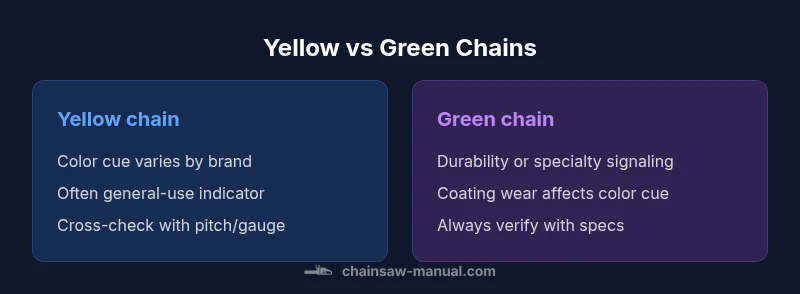
The phrase yellow vs green chainsaw chain refers to color-coded chains that some manufacturers use to differentiate chain styles, coatings, or intended applications. There is no universal standard that a yellow chain is one thing and a green chain another across all brands. For DIYers and professionals alike, color codes offer a quick visual cue, but they should never replace the essential checks of pitch, gauge, and drive-link count. In practice, you may encounter yellow chains on general-use bars and green chains on specialty lines, but assumptions are risky. This guide explains how to interpret color cues while keeping safety and performance at the forefront.
Color coding helps with inventory management on job sites, facilitates quick replacements after sharpening, and can align with safety or maintenance protocols. However, color may fade, be obscured by oil, or differ between retailers. Always cross-reference the chain's stamping, the saw model, and the manual. The most reliable way to verify a chain comes from the spec sheet, not color alone.
Throughout this guide we reference the primary color cues as practical aids. Remember that color coding is not a substitute for specifications; you still need to confirm pitch, gauge, drive links, and compatibility with your bar and saw.
Why Color Coding Matters for Maintenance and Safety
Color codes are mostly about quick recognition. On busy job sites or during routine maintenance, being able to glance at a chain and know its likely category can save time and reduce wrong-part errors. The yellow vs green contrast often signals a difference in one or more of these areas: coating durability, intended use, or a family of chains within a brand. The key is to use color as a starting point for verification, not as a final authority. Always rely on stamped specifications and the saw’s owner manual.
From a safety perspective, misidentifying a chain can lead to mismatched sharpening angles, improper tension, or incorrect drive-link counts. The color cue should prompt you to double-check the chain’s exact specs before mounting or cutting. If you notice color wear, consult maintenance logs and re-check the chain against the saw’s model number.
How Color Codes Vary Across Brands
Not all brands use yellow and green in the same way. In some brands, yellow might denote a standard, general-purpose chain, while green could indicate a wear-resistant coating or a premium line. In others, color coding might reflect a sequence of product generations or a line of sharpening tools compatible with the same chain family. Because there is no universal standard, always consult the manufacturer’s documentation for your specific chain and saw pairing. If the color seems inconsistent between retailers, verify the part number, chain pitch, and gauge directly with the seller or the brand’s support.
For chains used in professional settings, color coding can be part of a broader safety and workflow system. Teams may assign color-coded chains to different job sites, bar lengths, or cutting tasks. In these environments, color aids inventory control, but it does not replace the need to verify exact specifications.
Material, Coatings, and Wear Indicators
Color can reflect surface treatments such as chrome plating, ceramic coatings, or polymer paints intended to improve corrosion resistance or visibility. Over time, coatings wear, chip, or fade, which can alter the perceived color. This fading does not necessarily indicate reduced performance, but it does complicate color-based identification. Durable coatings generally correspond to higher-end lines, but that is not a guarantee of compatibility with your bar or saw. Inspect the edge finish, tooth geometry, and coating uniformity when you examine a yellow vs green chain. If you notice pitting, discoloration beyond normal wear, or bent drive links, replace the chain.
Always rely on metric specs (pitch, gauge, drive-link count) rather than color alone to assess performance expectations. Color cues may help flag a potential issue, but the decisive information comes from the chain’s stamped data and the saw’s requirements.
Compatibility: Pitch, Gauge, and Drive Links
Regardless of color, chain compatibility hinges on the saw and bar specifications. Pitch determines the distance between adjacent teeth, gauge indicates the thickness of the drive links, and the drive-link count must match the bar’s length. A yellow chain might look visually similar to a green chain, but if the pitch or gauge is wrong, you risk poor cutting performance, increased wear, or kickback risk. Always measure or verify: pitch, gauge, drive-link count, and the bar’s compatibility, and confirm that the chain is designed for the saw’s engine power and RPM range. Color should prompt you to check the specs, not replace them.
If you are replacing a chain, bring both the saw’s model information and the bar’s numbers to the retailer and compare them against the chain’s stamping. This reduces the chance of installing a chain with incompatible geometry.
Maintenance Tips for Color-Coded Chains
Maintenance for color-coded chains aligns with general chain care, with extra attention paid to color wear and coating integrity. Start with a visual check: look for fading, chips, or corrosion around the colored areas. Clean the chain with a neutral solvent or kerosene and dry before inspecting for tooth wear and plate integrity. Sharpening should follow the same practice you’d apply to any chain, ensuring the correct angle and depth gauge settings. After sharpening, re-check the color cues to ensure they still convey any required maintenance or replacement signals. Finally, lubricate and tension according to the saw’s manual. Color cues should guide you to scheduled maintenance intervals, not dictate them.
Documenting color condition over time helps predict when a chain needs replacement, enabling proactive maintenance rather than reactive repairs. If you notice unusual wear or color loss, it’s wise to test a new chain against your saw in a controlled environment before resuming work.
Real-World Scenarios: When Yellow Helps, When Green Wins
On a busy job site, color cues such as yellow vs green chains can speed up the process of selecting the right chain for a given task, especially when multiple chains are in use. For example, a yellow-coded chain might be used for general felling tasks, while a green-coded chain might indicate a high-durability variant for tough wood. In practice, you should still verify the chain’s pitch, gauge, and drive-link compatibility. The color cue helps your workflow and reduces mistakes, but it must be reconciled with the exact specifications. In precision work, a green-coded chain may mark a chain with enhanced wear resistance, yet it still must be matched to the bar and saw. Always prioritize specifications over color when in doubt.
Finally, consider color codes as part of a broader safety protocol: keep color-coded chains segregated by task, maintain a dedicated set of tools for sharpening only, and document color changes during inspections.
How to Verify Color Cues and Buy Safely
To reduce color-based errors, adopt a verification workflow. Step 1: note the color cue and cross-check the chain’s part number on the packaging. Step 2: compare pitch, gauge, and drive-link counts against the saw’s requirements. Step 3: reference the owner’s manual for color-meaning guidance specific to your brand. Step 4: if available, use the brand’s color-coded compatibility chart or digital lookups. Step 5: purchase from reputable retailers or directly from the manufacturer to avoid counterfeit mislabeling. A robust verification routine ensures that color cues support, rather than replace, reliable specs.
Keep a color-reference guide in your workshop. This quick reference reduces errors when you’re in the field, especially if gear is shared across teams or job sites.
Common Misconceptions About Color-Coded Chains
A frequent misconception is that color directly maps to performance characteristics like hardness, coating durability, or tooth geometry. In reality, color usually reflects branding or a maintenance signal rather than a universal spec. Another myth is that green means heavier duty and yellow means lighter duty; the opposite or a brand-specific rule may apply. Finally, some users assume that color-fading indicates imminent failure. Color aging can occur for cosmetic reasons without affecting safety-critical dimensions. Always confirm with the chain’s stamped data and the saw’s requirements rather than relying on color alone.
Quick Reference Checklist Before Purchase
- Confirm pitch, gauge, and drive-link count match your bar.
- Verify the color cue corresponds to your brand’s color-meaning guide.
- Check for coating integrity and tooth condition before mounting.
- Inspect the chain’s stamping and part number on the package.
- Purchase from reputable retailers to avoid mislabeled products.
Practical Takeaways When Selecting Color-Coded Chains
- Color cues can speed up identification but do not replace specs. - Always verify pitch, gauge, and drive links. - Reference the manufacturer’s color-meaning guide for your brand. - Ensure coating and wear indicators are intact before use. - Maintain a consistent workflow for color-coded chains across sites.
Future Trends: Color Coding and Safety Standards
As chainsaw technology evolves, color coding may become more standardized within brands or through enhanced labeling schemes. Some manufacturers are exploring color-coded data sheets and mobile apps to confirm compatibility quickly. Regardless of future trends, the core rule remains: color is a convenience, not a replacement for verified specifications. Ongoing education, updated manuals, and clear labeling will help users navigate yellow vs green chains with greater confidence.
Comparison
| Feature | Yellow chain | Green chain |
|---|---|---|
| Color convention | Brand-specific cue (no universal standard) | Brand-specific cue (no universal standard) |
| Intended use | General-use labeling varies by brand | Specialty or durability-focused lines vary by brand |
| Material/Coating cues | Painted or plated surface that may indicate line | Coatings intended for corrosion resistance or wear |
| Maintenance implications | Color fades with wear; use for maintenance scheduling | Color wear may signal replacement but confirm specs |
| Compatibility checks | Always verify pitch, gauge, and drive links | Always verify pitch, gauge, and drive links |
| Best for | Brand-identified cues for quick ID | Brand-identified cues for quick ID and durability |
Strengths
- Color cues speed identification during maintenance
- May align with brand-specific safety workflows
- Easy visual differentiation helps inventory control
- Supports quick decision-making when cross-checking manuals
Drawbacks
- No universal standard makes color unreliable alone
- Brand-specific meanings require manual cross-reference
- Color fading can mislead on color-only checks
- Overreliance on color can risk mismatches if specs differ
Color-coded cues aid quick ID but must be verified with specs.
Color cues are helpful for rapid recognition and workflow, but they do not replace checking pitch, gauge, and drive-link counts. Always cross-reference with the manufacturer’s data before mounting or cutting.
FAQ
What does yellow vs green color mean on chains?
Color cues are brand-specific and not standardized. They help identify the chain category at a glance, but you must verify the exact specs (pitch, gauge, drive links) from the manufacturer. Do not rely on color as the sole indicator of compatibility.
Color cues vary by brand; always check the specs to be sure.
Can I use yellow and green chains on the same saw?
Mixing color-coded chains is not recommended unless both chains share identical pitch, gauge, and drive-link counts. Color alone cannot guarantee compatibility and may compromise performance and safety.
Only same-spec chains should be used on one saw.
How do I verify color cues with specs?
Check the chain’s stamping, packaging, and the saw model against the manufacturer’s color-meaning guide. Cross-check pitch, gauge, and drive-link count with the saw’s requirements.
Always verify the exact specs; color is a cue, not a spec.
Are color-coded chains more durable than standard chains?
Durability depends on materials and coatings, not color alone. A color cue can indicate a coating, but performance still hinges on the correct chain type for your bar and saw.
Color does not guarantee durability; specs do.
Do all brands color-code chains?
No. Color-coding practices vary by brand. Some brands use color as a quick ID, while others rely on stamping and model numbers. Always consult the brand’s color-meaning guide.
Not all brands color-code; check the brand guide.
What maintenance steps matter most for color-coded chains?
Follow standard maintenance: inspect tooth wear, ensure proper tension, sharpen per the chain type, and verify coating integrity. Use color cues to guide maintenance windows but rely on specs for the exact process.
Do the usual chain maintenance and trust the specs more than color.
The Essentials
- Verify pitch, gauge, and drive links before trusting color.
- Color codes vary by brand; don't rely on color alone.
- Cross-check with the manual and chain stamping.
- Inspect coating integrity during routine maintenance.