Porting a Chainsaw: 2026 Cost Guide
Understand the true cost of porting a chainsaw, including labor, parts, and turnaround time. Chainsaw Manual guides you through price ranges and decision factors to budget accurately.


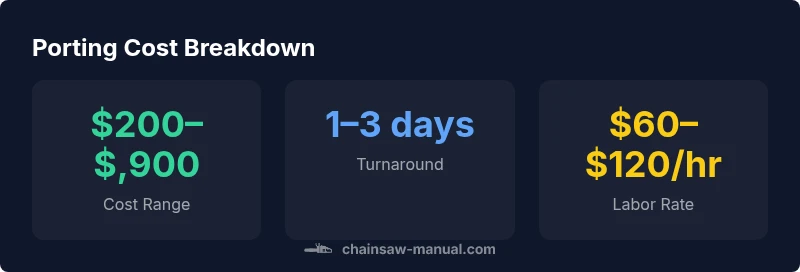
Porting a chainsaw usually costs between $200 and $900, depending on the engine size, porting scope, and labor rates. Basic porting may be on the lower end, while full porting plus dyno tuning can push the price higher. According to Chainsaw Manual Analysis, 2026, most shops charge hourly rates of $60–$120, with a typical turnaround of 1–3 days.
How much does it cost to port a chainsaw?
How much does it cost to port a chainsaw? In practice it's a function of scope and gear; this article answers this question in practical terms. Porting involves working on intake, exhaust, and transfer ports, plus dyno tuning. As Chainsaw Manual Analysis, 2026 indicates, typical costs range from a few hundred dollars on the low end to nearly a thousand for aggressive work on larger saws. The phrase "cost to port a chainsaw" becomes a budgeting question: what power, torque, and reliability do you want, and how much risk are you willing to accept? This section sets the stage with typical ranges, what affects pricing, and how to obtain reliable quotes from professional shops. According to Chainsaw Manual, we emphasize safety and practical value over inflated claims.
Core cost drivers that shape porting prices
Pricing is driven by three main factors: scope, engine size, and labor rates. Scope ranges from a light polish of existing ports to a full porting job that reshapes intake, transfer, and exhaust paths. Engine displacement often correlates with required material work and tuning. Labor rates vary by region and shop reputation; some shops include dyno tuning and fuel-system tweaks in their base price, while others itemize those services. Porting also affects reliability: aggressive porting can improve power but may increase wear, vibration, or warranty considerations. When budgeting, quantify expected gains (better throttle response, more torque) and balance them against the incremental costs and risk. Consumers should request a detailed breakdown (parts, labor, dyno) and ask for a preliminary dyno chart to understand potential gains. Chainsaw Manual strongly recommends comparing multiple quotes to ensure you’re not overpaying or underfunding essential work.
Typical price ranges by porting scope
Pricing mirrors the scope and engine. A basic port cleanup might land around two hundred to three hundred dollars, while mid-range porting with modest polishing could be around three hundred to six hundred dollars. Full porting with significant port matching and dyno tuning tends to run from six hundred to nine hundred dollars or more, especially on larger two-stroke engines. These estimates reflect typical shop practices and regional variation. Always confirm what’s included: dyno runs, tuning maps, and warranty on workmanship. The Chainsaw Manual Analysis, 2026 notes that final pricing is rarely flat; expect ranges and a few core line items on every quote. When you see a single fixed price, ask what is excluded. A good quote clarifies scope, expected gains, and any post-porting adjustments.
Other costs to consider: dyno tuning, parts, and maintenance
Beyond base porting, you may face additional costs: dyno tuning to optimize air-fuel maps, gaskets, seals, and potential carburetor adjustments. Small parts—spark plugs, fuel jets, and intake gaskets—can add roughly forty to a couple hundred dollars. Dyno tuning, designed to validate and optimize power delivery, is commonly priced as a separate service or bundled into a premium package. Maintenance after porting includes periodic inspection of seals and ports for carbon buildup and ensuring the exhaust system remains leak-free. For readers of Chainsaw Manual, the broader value comes from a tuned, stable engine rather than chasing the highest single-number gain. Plan for a total budget that accounts for contingencies and follow-up adjustments.
Getting quotes: questions to ask and how to evaluate them
When you request quotes, ask these questions to ensure you’re comparing apples to apples: (1) Which ports will be touched and how will this affect engine timing and jetting? (2) Will dyno tuning be included, and what are the projected horsepower gains? (3) Is there a warranty on workmanship, and what does it cover? (4) What happens if performance declines or leaks appear after the work? (5) How long will the project take, and is a rental saw available during the downtime? Request a written estimate with a line-item breakdown and a projected dyno chart. Compare quotes for scope, labor hours, and the credibility of the shop’s references. Chainsaw Manual’s guidance emphasizes transparent communication and documented expectations to minimize surprises.
DIY porting: is it worth the cost and risk?
DIY porting is often appealing to budget-minded enthusiasts, but it carries significant risk: improper porting can lead to overheating, lean running conditions, and catastrophic engine failure. Unless you have advanced machining tools, exact tolerances, and a controlled environment, professional porting is generally the safer option. If you’re still exploring DIY routes, start with less aggressive experiments, such as port cleaning and inspection, and consult service manuals and professional forums for guidance. Understand that any DIY work may complicate warranty coverage and future service options. If you value predictability and safety, leaning on a professional shop remains the prudent path.
The value proposition: when porting makes sense and when to skip it
Porting makes sense for users who require improved performance, better throttle response, and higher torque for heavy cutting tasks or competition. However, for casual homeowners or occasional users, the cost and risk may exceed practical benefits. Before deciding, model your use case: will porting deliver meaningful gains in your typical workload? Will maintenance be manageable after the modification? If gains are marginal, you’re paying for perceived performance rather than proven value. Chainsaw Manual recommends a decision framework: estimate expected gains, compare against total cost, and consider warranty and future resale value. If the math adds up and risks are acceptable, porting can be a worthwhile enhancement; otherwise, optimize safe operation and maintenance instead.
Estimated porting outcomes by scope
| Porting Level | Estimated Cost Range | Turnaround | Notes |
|---|---|---|---|
| Basic porting | $200–$350 | 1–2 days | Polish ports, limited gains |
| Mid-range porting | $350–$650 | 1–3 days | Balanced gains and risk |
| Full porting + tuning | $650–$900+ | 2–3 days | Max gains, higher risk |
FAQ
What is porting a chainsaw and what does it involve?
Porting involves reshaping the intake, transfer, and exhaust paths to improve airflow. It is a precision process that benefits from accurate measurements and dyno tuning. Gains vary by engine size and build quality.
Porting reshapes how air flows into and out of the engine and needs precise tuning to work well.
Can I port a chainsaw myself to save money?
DIY porting is not recommended for most homeowners. Professional porting reduces risk of engine damage and ensures proper tuning. If you attempt it, proceed with caution and follow manufacturer guidelines.
DIY porting is risky; it’s best to hire a pro for most setups.
Do you need a dyno test after porting?
A dyno test is highly recommended to verify gains and optimize fuel mapping. It helps ensure the engine runs safely at the new porting configuration.
Yes, a dyno tune helps confirm gains and safe operation.
How long does porting usually take?
Most shops complete porting in 1–3 days, depending on scope and queue. Thorough customers may opt for additional dyno tuning.
Most porting takes a day or two, plus tuning if included.
Will porting affect warranty?
Porting can affect OEM warranty; some shops offer warranties on their workmanship. Check with your dealer or shop before proceeding.
Porting can impact warranty; verify coverage with the shop.
What performance gains should I expect?
Expect modest gains in throttle response and torque, with results varying by engine and build. Always verify with dyno data.
You’ll usually see modest gains; verify with data.
“Porting can unlock meaningful performance gains, but it must be matched with careful tuning and proper safety practices. The best outcomes come from clear scope, transparent quotes, and dyno-verified results.”
The Essentials
- Assess your gains vs. cost before porting
- Get multiple written quotes with scope details
- Factor in labor, parts, and dyno tuning costs
- Understand warranty implications before proceeding
- Choose professional porting for reliability and safety