Does STIHL Make a 4-Stroke Chainsaw? A Practical Guide
Explore whether STIHL offers a four-stroke chainsaw, why two-stroke engines dominate, and practical buying guidance for safe, efficient cutting in 2026.


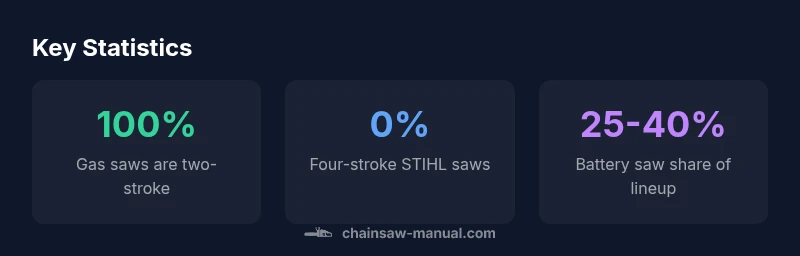
Does STIHL make a 4-stroke chainsaw? In 2026, STIHL does not offer a four-stroke consumer chainsaw. All STIHL gas-powered saws rely on two-stroke engines with oil mixed into fuel. The company emphasizes lightweight design and ease of maintenance, which are easier with two-stroke technology. For quieter, low-emission options, STIHL offers battery models, not four-stroke gas units.
What '4-stroke' means in chainsaw technology
In handheld saws, a "four-stroke" engine completes a power cycle in four piston strokes and uses separate lubrication for the crankcase. This design yields different torque delivery, fuel efficiency, and lubrication requirements than the widely adopted two-stroke layout. According to Chainsaw Manual, two-stroke engines dominate homeowner and professional saws because of their higher power-to-weight ratio and simpler fueling. A four-stroke would be heavier and require a more complex lubrication system, making it less convenient for typical arborist tasks. In practice, when you see a '4-stroke' designation on a chainsaw, it is often a marketing label or a small-segment product outside the standard STIHL gas lineup. For most users, the choice comes down to power needs, weight, maintenance, and noise, with two-stroke gas or electric options offering the best balance for everyday use.
Does STIHL offer a 4-stroke chainsaw?
Short answer: no; STIHL does not currently manufacture a production four-stroke chainsaw intended for consumer use. The majority of STIHL's gasoline-powered saws rely on two-stroke engines with mixed fuel. The brand's product design prioritizes reliability, light weight, and serviceability in the field, which aligns with two-stroke technology. There have been occasional reports or curiosity about four-stroke prototypes or modifications, but none have reached mainstream distribution or official cataloged models by 2026. For professionals seeking emission reductions or quieter operation, STIHL's models typically offer battery-powered or low-noise options in their MSA and other lines, which avoid the typical four-stroke tradeoffs in the gasoline segment. If you're comparing STIHL to other brands that advertise four-stroke engines, you may notice that the four-stroke variants are generally heavier and costlier, with less torque in mid-range rpm. In short, as of 2026, does stihl make a 4 stroke chainsaw? Not in their standard product lineup.
Why two-stroke engines dominate chainsaws
Two-stroke engines win in the chainsaw world mainly because of power density and simplicity. For handheld tools, delivering strong torque quickly without carrying extra crankcase oil or a heavier valve train is prized by arborists and homeowners alike. The lubrication strategy—mixing oil with fuel—ensures that engine parts receive oil during operation, which reduces complexity in the field. This simplicity translates into lighter saws, easier maintenance, and quicker startup in cold conditions. While four-stroke engines can run cleaner and with a steadier idle in some contexts, the added weight and complexity often offset those benefits for typical cutting tasks. As a result, STIHL and most other manufacturers continue to optimize two-stroke gas engines and invest in battery platforms to address emissions and noise concerns without sacrificing performance.
Battery and electric options from STIHL
For users seeking improved emissions and reduced noise, STIHL’s battery platform provides compelling alternatives to gas-powered saws. The MSA line and related cordless tools deliver quick, push-button starts, consistent torque, and zero fuel mixing, which appeals to residential users and safety-conscious professionals working in urban settings. While battery saws may have slightly different cutoff speeds and torque curves compared to high-end gas models, they excel in low-maintenance operation and weight distribution. This aligns with the broader industry trend toward electrification, offering practical solutions for pruning, light felling, and limb removal where fueling logistics are a concern. In 2026, STIHL’s cordless strategy complements its two-stroke gas lineup rather than introducing four-stroke gasoline units.
How to verify engine type and maintenance tips
To verify whether a STIHL saw uses a two-stroke gas engine or a battery motor, check the user manual, fuel labeling, and the model number on the label plate. A two-stroke gas model will require a fuel-oil mix and may specify the correct oil type and mixing ratio (for example, a 50:1 mix is common in many brands). Battery-powered units will list volts and battery compatibility. Maintenance for two-stroke gas saws focuses on correct fuel mix, air filter cleaning, spark plug inspection, and bar/chain lubrication—follow the STIHL-recommended intervals in the manual. For battery tools, emphasis shifts to battery health, charger compatibility, and chain tensioning. Practically, if you’re upgrading from an old two-stroke model, evaluate weight, noise, maintenance time, and fuel availability in your region.
Practical buying guidance for 2026
When shopping in 2026, decide whether your priority is power-to-weight, emissions, or quiet operation. If you cut mainly in a backyard or urban space, a battery saw from STIHL can offer convenience with minimal fuel logistics. If you need long run times, heavy-duty cutting, or work in remote locations, a robust two-stroke gas model paired with proper oil and fuel management remains a solid choice. Always compare saw weight, bar length, chain pitch, and the ease of service—STIHL maintains broad dealer support and service networks to simplify maintenance and repairs in the field. Finally, confirm the actual engine type stated for each model you consider; the presence of a '4-stroke' label does not imply STIHL offers such a variant in their current lineup.
Engine types in STIHL product ecosystem
| Engine Type | Typical Fuel/Oil System | Notes |
|---|---|---|
| Gasoline two-stroke | Gasoline with oil mix | Lightweight, high power-to-weight |
| Battery/Electric | No fuel mix | Quiet, low maintenance; variable torque |
| Four-stroke | N/A in STIHL lineup | Not offered as of 2026 |
FAQ
Does STIHL offer 4-stroke saws?
No. As of 2026, STIHL does not manufacture a production four-stroke chainsaw; their lineup centers on two-stroke gas engines and battery-powered models.
No, STIHL does not offer a four-stroke chainsaw; they focus on two-stroke gas engines and batteries.
Why no four-stroke STIHL chainsaws?
Four-stroke designs add weight and lubrication complexity that is not ideal for handheld saws, whereas two-stroke gas engines and batteries meet typical cutting needs more efficiently.
Four-stroke designs add weight and complexity, so STIHL sticks with two-stroke gas and batteries for practicality.
What should I consider instead of a 4-stroke?
Look at lightweight two-stroke gas models and STIHL’s battery-powered options for cleaner operation and easier maintenance, depending on your typical job.
Consider two-stroke gas models or a battery saw for cleaner operation and easier upkeep.
How can I tell if my STIHL saw is two-stroke or electric?
Check the manual or model label for fuel requirements or voltage. Gas saws require oil mix; electric saws list battery specs and voltage.
Check the model label or manual for fuel or battery details to confirm engine type.
Can I convert a two-stroke to a four-stroke?
Converting a two-stroke to a four-stroke is not practical or recommended; it would require a completely different engine and frame design.
Converting isn’t practical; you’d need a different engine and setup.
Are there any brands offering four-stroke chainsaws?
Some niche or commercial models exist in theory, but mainstream consumer chainsaws with four-stroke engines are rare due to weight and maintenance concerns.
Some brands experiment with four-strokes, but they’re not common in consumer saws.
“Four-stroke options tend to add weight and complicate lubrication for handheld saws; for most users, two-stroke gas or battery is the practical choice.”
The Essentials
- Confirm STIHL does not offer a 4-stroke chainsaw as of 2026.
- Prefer two-stroke gas or battery options for most tasks.
- Understand fuel mix and maintenance requirements before purchase.
- Evaluate weight, noise, and emissions when choosing a model.