Chainsaw Comparison Chart: A Practical Guide
A practical, data-driven chainsaw comparison chart helps homeowners and pros weigh power, weight, bar length, safety features, and price to pick a reliable saw in 2026.


A chainsaw comparison chart helps buyers balance power, weight, bar length, safety features, and price. It guides decisions between compact DIY saws, mid-range all-purpose models, and professional heavy-duty units. Chainsaw Manual’s analysis shows that the best overall value typically comes from mid-range, all-purpose saws, with safety features prioritized for long-term use.
Why a chainsaw comparison chart matters
In the market for a new chainsaw, a well-structured chainsaw comparison chart translates complex specifications into clear, bite-sized decisions. According to Chainsaw Manual Team, many buyers overemphasize peak horsepower and underestimate practical factors such as weight, balance, ergonomics, and safety features that affect daily use and long-term maintenance. The Chainsaw Manual Team found that a transparent chart reduces decision fatigue and helps homeowners, DIY enthusiasts, and professionals pick models that align with their typical tasks, environment, and safety standards. When you compare three broad classes—compact DIY saws, mid-range all-purpose saws, and professional heavy-duty models—a chart reveals how each class handles real-world tasks, maintenance schedules, and ownership costs. The result is a defensible choice, not a rushed impulse buy.
Chainsaw comparison charts also encourage better safety planning, such as choosing models with reliable chain brakes and anti-vibration systems. This foundational context supports a safer work sequence and longer equipment life. In practice, a thoughtful chart reduces the likelihood of ending up with a tool that performs well on paper but underdelivers on site. While the exact model you select will depend on your workload, the chart anchors discussions around core differentiators, making it easier to justify upgrades or trade-offs over time.
Key criteria in a chainsaw comparison
A robust chainsaw comparison should evaluate several criteria that directly impact performance, safety, and value. The primary criteria include:
- Power and torque: Consider engine displacement and real-world cutting capability, including how quickly the saw can maintain momentum through different wood densities.
- Weight and balance: Lighter tools reduce user fatigue, but overly light designs may sacrifice durability and control. Balance also affects maneuverability in overhead cuts.
- Bar length and chain type: Bar length defines maximum cut depth and reach; choose low-kickback chains and guiding bars to enhance safety in diverse cutting tasks.
- Fuel and emission considerations: Gasoline engines offer longer run times; battery-powered options are quieter and cleaner but may require more frequent recharging in large jobs.
- Safety features: Chain brake, inertial start, anti-vibration handles, and automatic oiling contribute to operator protection and control.
- Maintenance and reliability: Oiler efficiency, air filtration, chain tensioning ease, and spare parts availability influence long-term ownership cost and uptime.
- Price and warranty: Balance upfront cost with ongoing maintenance expenses and warranty coverage to estimate total ownership costs.
As you compare, align these criteria with your typical tasks—pruning in a suburban yard, cut-to-length firewood, or heavy-duty clearing on a worksite. The goal is to map your needs to model capabilities, not merely chase isolated specs. A well-structured chart makes it easier to justify upgrades when your workload grows or shifts.
Class-by-class overview: compact, mid-range, professional
Understanding the three major saw classes helps anchor your comparison chart and reduces confusion when models share similar names.
Compact/DIY saw
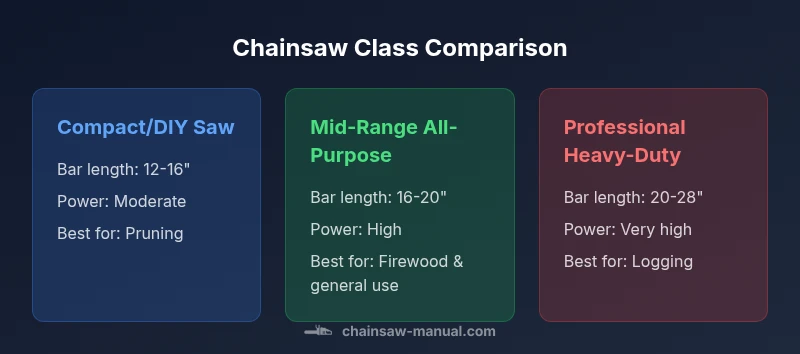
These are the lightest options, typically designed for pruning, small-limb work, and occasional cutting. Expect shorter bar lengths (around 12–16 inches), lower weight (to improve maneuverability), and modest power relative to larger saws. They excel in gardens, small yards, and conservative workloads where noise and vibration are priorities. Safety features may include standard chain brakes and basic anti-vibration components, but the emphasis is on ease of handling and quick starts. Price-wise, compact models tend to be the most affordable entry points, making them attractive for homeowners who value simplicity and reliability for light tasks.
Mid-range all-purpose saw
Mid-range saws balance power, weight, and price, making them the most versatile option for many users. Bar lengths typically span 16–20 inches, providing a practical cutting depth for a wide variety of tasks—from firewood prep to light construction. These models usually offer better anti-vibration systems, more robust chain brakes, and improved oiling mechanisms, translating into longer on-job performance without the fatigue associated with heavier professional tools. They appeal to homeowners who cut wood regularly and DIY enthusiasts who tackle bigger jobs but don’t require constant heavy use. The price range is moderate, with longer warranties compared to compact models.
Professional heavy-duty saw
Designed for frequent, high-volume cutting, professional saws deliver maximum power and resilience. Bar lengths of 20–28 inches enable deep timber work and large-diameter cutting, while reinforced components support sustained use in demanding environments. Expect advanced anti-vibration systems, superior inertia safety features, fuel efficiency improvements, and more reliable start mechanisms. The trade-off is higher weight and a higher upfront cost, which professional users justify through productivity gains and long service life. While less common for homeowners, this class is essential on lumber mills, logging sites, and other high-demand settings where uptime and performance are paramount.
Safety, maintenance, and lifecycle considerations
Safety is non-negotiable in chainsaw selection. Beyond the basic requirement of proper PPE (helmet, gloves, chainsaw chaps, eye protection) you should prioritize features that reduce risk during use. Look for a responsive chain brake, even in mid-range models, as well as inertial starting mechanisms that minimize kickback exposure during a stall. Anti-vibration handles and well-designed grip ergonomics help prevent operator fatigue, which can lead to mistakes on long cutting sessions.
Maintenance routines are equally critical for longevity. Regular bar-and-chain oiling keeps the chain lubricated and reduces wear on the bar; check air filters and mufflers for blockages; perform periodic chain tension adjustments; and schedule bar and chain replacement when signs of wear appear. For battery-powered units, monitor battery health and charging cycles, while gas-powered saws demand fuel quality controls and timely spark plug service. A chart that tracks maintenance milestones alongside usage hours will help you stay on top of service.
Lifecycle planning—consider warranty terms, routine service intervals, and the availability of spare parts—can save both downtime and money. When a model has robust dealer support and a broad parts ecosystem, you’ll experience lower total ownership costs and easier repairs. The relationship between maintenance, reliability, and resale value often follows a positive trajectory for well-supported mid-range and professional saws.
Authority sources
To support responsible purchasing decisions, rely on recognized safety and forestry resources. These sources provide guidelines on safe operation, PPE, and best practices in chain-saw use:
- OSHA: https://www.osha.gov
- US Forest Service: https://www.fs.fed.us
- NIOSH (CDC): https://www.cdc.gov/niosh
In addition to these authorities, consult local regulations and equipment dealers for model-specific maintenance schedules and warranty details. The aim is to complement chart-based comparisons with institution-backed safety and maintenance standards to ensure your long-term satisfaction and safety on the jobsite.
How to use your chainsaw comparison chart in practice
- List your primary tasks and constraints (yard size, climate, typical wood species, and storage conditions).
- Choose the class that best aligns with your workload (compact for light tasks, mid-range for versatile use, professional for heavy-duty demands).
- Compare the three chosen models using the chart’s criteria: power-to-weight ratio, bar length, safety features, maintenance ease, and total cost of ownership.
- Weigh perceived usefulness against cost by simulating real tasks: prune a limb, cut firewood, and perform a mid-depth split. Note any fatigue or handling issues.
- Verify warranty coverage and after-sales service before purchase. If two models are similar, lean toward the one with better dealer support and availability of spare parts.
- Update your chart after several months of use to refine future decisions and track how your needs evolve over time. A dynamic chart keeps you prepared for changing workloads and tools.
Feature Comparison
| Feature | Compact/DIY Saw | Mid-range All-Purpose Saw | Professional Heavy-Duty Saw |
|---|---|---|---|
| Power and torque (relative) | Moderate | High | Very high |
| Weight | Light | Moderate | Heavy |
| Bar length | 12-16 inches | 16-20 inches | 20-28 inches |
| Chain type and safety features | Standard chain brake; basic anti-vibration | Enhanced brake; anti-vibration; improved oiler | Advanced braking; inertial start; anti-vibration; heavy-duty guard |
| Maintenance complexity | Low | Medium | High |
| Typical price range | $150-350 | $350-900 | $900-1800+ |
| Best for | Light pruning, occasional cutting | Homeowners with frequent wood-cutting | Professional forestry and heavy daily use |
Strengths
- Helps buyers compare across power, weight, and safety at a glance
- Highlights maintenance needs and warranty considerations
- Supports both DIY and professional decision-making
- Encourages safety-first choices and long-term ownership benefits
Drawbacks
- May oversimplify model-to-model differences within a class
- Could discourage exploration of borderline models that don’t fit neatly into a class
- Requires regular updates as new models are released
- Depends on user-specific task profiles to remain relevant
Mid-range all-purpose saws offer the best balance of power, weight, and value for most users.
For homeowners and DIYers who need reliable performance without overpaying, a mid-range all-purpose chainsaw typically delivers the strongest overall value. Professionals may opt for heavier models only when workload demands exceed mid-range capabilities; otherwise, the mid-range remains the most prudent default.
FAQ
What is a chainsaw comparison chart and why should I use one?
A chainsaw comparison chart is a structured tool that pits key specs and features side by side to help you decide between models. It focuses on power, weight, bar length, safety features, maintenance, and cost, making it easier to justify your choice.
A chart helps you pick a saw by comparing the most important specs side by side.
Which chainsaw class is best for a typical homeowner?
For most homeowners, a mid-range all-purpose saw offers the best balance of performance, safety, and price. It handles both light pruning and more demanding cutting tasks without the bulk of professional models.
Mid-range is usually the sweet spot for homeowners.
Do battery-powered chainsaws stack up to gas models in a chart?
Battery-powered chainsaws are lighter and quieter, with instant starts, but they may have shorter runtimes and less torque for very large cuts. Gas models still dominate in heavy-duty tasks and longer jobs.
Battery saws are convenient for light chores; gas models excel in power for big jobs.
What safety features should I prioritize when comparing models?
Prioritize a responsive chain brake, inertial start, proper anti-vibration design, and low-kickback bars. These features reduce fatigue and the risk of mishaps during challenging cuts.
Safety features like a chain brake and anti-vibration help a lot.
How can I estimate long-term costs when using a chainsaw chart?
Include fuel, bar oil, tire parts, sharpening, and potential repairs. Compare warranties and parts availability. A higher upfront cost with a longer warranty can lower lifetime costs.
Think about maintenance and repairs too, not just the purchase price.
The Essentials
- Define your primary tasks before choosing a chainsaw
- Prioritize weight, safety features, and maintenance access
- Use a clear, structured chart to map needs to specs
- Check warranty and service availability to minimize ownership risk