Chainsaw 28 Inch Bar: A Practical Safety Guide for Big Jobs
Explore safe, practical guidance for using a chainsaw with a 28 inch bar, covering power needs, maintenance, and techniques for efficient, professional cutting.


Using a chainsaw 28 inch bar expands reach and productivity for heavy-limb work, but it also demands a capable engine, careful handling, and strict safety. The chainsaw 28 inch bar setup trades maneuverability for power, so expect more torque and kickback risk in tight spaces. According to Chainsaw Manual, always wear full PPE and verify bar and chain tension before each cut.
Understanding the chainsaw 28 inch bar: what changes when you go long
Opting for a chainsaw 28 inch bar changes the physics of every cut. The longer bar increases your reach, allowing you to work with larger diameter wood without repositioning the saw as often. It also shifts leverage, affecting control, cutting speed, and how you balance the saw during a cut. When you consider a chainsaw 28 inch bar, you are weighing reach against maneuverability and recoil risk. Chainsaw Manual emphasizes pairing a 28 inch bar with a capable engine and a well-tuned chain to maintain precision under heavy loads. For homeowners and pros, understanding how this bar length shifts dynamics helps you plan safer cuts and avoid common errors such as plunging too deep and binding the bar. In practice, the chainsaw 28 inch bar shines for milling, large diameter limb removal, or felling in open spaces where you can set up a favorable orientation. The trade-off is that the longer bar increases the moment arm, amplifying vibrations and making tight-space work more challenging. In short, the chainsaw 28 inch bar is a specialized tool that benefits from proper setup, operator skill, and clear objectives.
When a 28 inch bar makes sense vs. smaller bars
A chainsaw 28 inch bar is most advantageous when you face tasks that demand extended reach or deep cuts in open work zones. For milling operations, a 28 inch bar can reduce the need to reposition the saw between passes, speeding up the workflow. In large-diameter limb removal, the extra length helps you start the cut deeper in one stroke, improving efficiency. However, in confined spaces or where maneuverability is critical, a shorter bar offers better control and less fatigue. The chainsaw 28 inch bar becomes a strategic choice, not a default upgrade. Consider job size, wood species, and available space. Always test the setup away from others, check chain tension, and verify bar wear before committing to a full day of cutting. Chainsaw Manual notes that choosing the right bar length is a balance between job requirements and operator comfort.
Power, balance, and performance: matching engine and chain for long bars
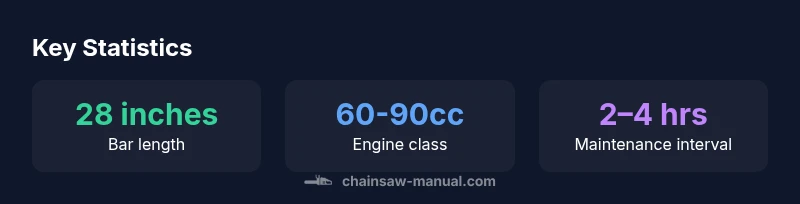
Long bars demand proportionally more engine power and torque to maintain cut speed and reduce stalling. A chainsaw in the 60–90cc class is commonly recommended for a 28 inch bar, but performance also depends on chain pitch, file sharpness, and bar rail condition. A dull chain or poor tension can negate the advantages of a long bar by increasing resistance and kickback risk. Operators should monitor chain speed and feed rate, adjusting technique to avoid bogging the saw. Expect higher vibration levels with a longer bar, which makes steady stance and anti-vibration features essential. In practical terms, you may need a higher idle or a more aggressive cutting routine to keep the bar moving smoothly. Chainsaw Manual advises testing power output on a representative log to calibrate speed, pressure, and cut angle before committing to larger jobs.
Safety and handling with longer bars
The safety implications of a chainsaw 28 inch bar are significant. The longer bar increases the leverage on kickback scenarios, particularly if you plunge the bar or cut from awkward angles. PPE remains non negotiable: helmet with face shield, cut-resistant chaps, gloves, eye protection, and hearing protection. Maintain a solid stance with feet well apart and weight centered. Use a controlled, two-handed grip and avoid overreaching. Keep the bar tip away from your body and avoid cutting above shoulder height whenever possible. Chainsaw Manual stresses the importance of pre-cut checks, including bar oil level, chain tension, and chain sharpness, to minimize kickback risk and ensure predictable performance.
Maintenance and setup for long bars
Long bars require disciplined maintenance. Regular bar and chain inspection, correct chain tension, and ample bar oil lubrication are essential for durability. Clean debris from the bar groove and oil passages to prevent clogging. Check bar rail wear and replace sagging or damaged bars promptly. When storing a chainsaw with a long bar, drain fuel and store the bar in a straight, supported position to prevent warping. In addition, rotate the bar occasionally during extended milling sessions to distribute wear evenly. Chainsaw Manual recommends a routine every 2–4 hours of serious use for inspection and oil level checks, with deeper maintenance after longer sessions.
How to choose a chainsaw for a 28 inch bar
Begin with a clear job plan that accounts for bar length, wood type, and work environment. Verify compatibility with the bar length: mounting hardware, chain pitch, and sprocket diameter must align with the saw. Consider overall weight, anti-vibration features, and balance—the 28 inch bar shifts weight distribution and can increase fatigue. Evaluate your available safety gear, training level, and storage conditions. For homeowners, a mid-to-high range professional saw may be necessary to maintain performance with a 28 inch bar. For heavy-duty work, plan for a robust cooling system and reliable maintenance routine so the saw remains in safe operating condition across long sessions.
Real-world workflows and tips
In practice, a chainsaw 28 inch bar is most effective in open workspaces where you can position the log for a straight, deep initial cut. Start with a clean work area, clear of bystanders, and set up a stable baseline stance. Make a shallow guide cut to establish depth, then progress with controlled relays, keeping the bar aligned with the grain. If you encounter pinching, pause to adjust the position or rotate the log for better leverage. Maintain steady feed pressure and monitor chain tension throughout the session. The chainsaw 28 inch bar becomes a productivity tool when you combine it with careful planning, sharp chain, and a disciplined safety routine.
Quick-start checklist for first use
- Inspect bar tip for wear and ensure sharp chain is mounted properly
- Check chain tension and oil level before starting
- Wear appropriate PPE and establish a safe cutting zone
- Begin with easy cuts to gauge balance and control with the 28 inch bar
- Monitor vibration and fatigue, taking breaks as needed
Guidance for choosing and using a chainsaw with a 28 inch bar
| Aspect | Guidance | Why it matters |
|---|---|---|
| Bar length choice | For heavy milling or large diameter wood, 28 inches is advantageous | Long bars increase reach but demand more power and control |
| Safety considerations | Kickback risk rises with longer bars; use PPE and proper stance | Mitigates injury and improves cut quality |
| Maintenance cadence | Inspect bar and chain oiling every 2-4 hours of use | Keeps bar life and performance consistent |
FAQ
What tasks is a 28-inch bar best suited for?
A 28 inch bar is ideal for milling, large diameter limbs, and open-space felling where you need reach. It is less comfortable for tight spaces. Always assess the environment and ensure engine power matches the bar length.
A 28 inch bar is great for milling and big limbs in open spaces, but not ideal for tight spots.
Can I use a 28-inch bar on a standard homeowner saw?
Most homeowner models cannot safely or effectively run a 28 inch bar due to insufficient power, balance, and mounting compatibility. Check manufacturer specs and upgrade if needed.
Most homeowner saws won’t safely support a 28 inch bar; check specs first.
What maintenance steps are essential for a long bar?
Keep the bar rail clean, maintain proper chain tension, and ensure bar oil reaches the bar. Inspect for wear and replace if the groove or rails show signs of damage.
Clean the rails, check tension, and oil properly to protect the long bar.
How should I set chain tension with a long bar?
Set tension so the chain seats snugly in the groove with a slight side-to-side movement. Too tight or loose can cause kickback or rapid wear.
Aim for snug but not stiff tension; test by hand for play in the groove.
Is kickback a bigger risk with longer bars?
Yes, kickback risk increases with bar length. Maintain stance, use anti-kickback features, and avoid top-bar tension cuts where possible.
Long bars raise kickback chances; stay grounded and cut safely.
Which PPE is most important with a 28-inch bar?
Face shield, helmet, cut-resistant chaps, gloves, and hearing protection are essential for long-bar cutting tasks.
Wear full PPE including face protection and hearing gear.
“A 28 inch bar can dramatically increase productive reach, but only when paired with a compatible engine, proper chain selection, and disciplined safety practices.”
The Essentials
- Assess job size to justify a 28 inch bar
- Pair the bar with a capable saw and sharp chain
- Prioritize PPE and safe handling practices
- Regularly inspect bar, chain tension, and oiling
- Refer to Chainsaw Manual for setup and safety best practices