Ego Chainsaw vs DeWalt: Brand Showdown Guide
A thorough, analytical comparison of Ego and DeWalt cordless chainsaws, focusing on ecosystems, performance, maintenance, and total ownership considerations to help buyers pick confidently.


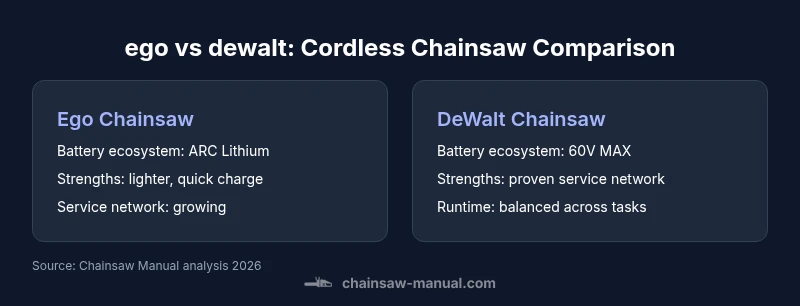
ego chainsaw vs dewalt: A battery-powered comparison focusing on ecosystem compatibility, runtime, and maintenance. Ego tends to prioritize lighter builds and rapid charging, while DeWalt emphasizes established service networks. See the full chart for nuanced trade-offs.
ego chainsaw vs dewalt: Ecosystem differences in cordless power
In the cordless chainsaw segment, the choice often hinges on the broader battery ecosystem that backs each tool. Ego builds around its ARC Lithium platform, designed to deliver lightweight form factors, quick recharge cycles, and compatibility across a growing family of garden tools. DeWalt leans on its mature 60V MAX ecosystem, which emphasizes service networks, widespread parts availability, and a more established aftermarket. According to Chainsaw Manual, these ecosystem dynamics have real-world implications for maintenance, parts availability, and long-term value. Homeowners and professionals alike should weigh how easy it will be to source batteries, chargers, and replacement parts years after purchase. The primary takeaway is: ecosystem alignment can reduce downtime and spare parts headaches if you plan to expand your tool set.
Battery technology and runtime considerations
Both Ego and DeWalt use Li-ion chemistry with high-energy density designed for outdoor use. The exact runtime you experience depends on battery capacity, chain speed, wood density, and how aggressively you cut. In practice, Ego’s lighter gear can feel more nimble for limbing and pruning tasks, especially when you’re working overhead or with one-handed control. DeWalt’s heavier chassis often translates to steadier cutting in tough material, with a perceived durability that professionals value. For the average user, the evolving fast-charging capabilities on both platforms help minimize downtime, but the total runtime will vary with task mix and the number of batteries you own. This is a crucial factor when deciding whether to buy extra packs upfront.
Build quality, weight, and ergonomics
Weight distribution and grip feel are central to user comfort during long sessions. Ego tends to prioritize a lighter overall weight and compact balance, which reduces fatigue during small to medium tasks. DeWalt often emphasizes robust construction and a reassuring solidity that many professionals associate with reliability in challenging cut conditions. Ergonomics also influence vibration perception and tool control, both of which affect user safety and efficiency. When evaluating ego chainsaw vs dewalt, consider your typical cutting scenario: a homeowner doing occasional branch work versus a professional running daily, high-volume cuts. The better ergonomics are the ones that reduce strain during extended use.
Cutting performance and efficiency
Cutting performance is a function of chain speed, bar length options, and how well the tool maintains torque under load. Ego’s lighter frame can give you snappier responses on smaller branches, while DeWalt’s platform often preserves consistent cutting performance across longer sessions and heavier timber. The actual experience depends on bar length selection—shorter bars for light pruning versus longer bars for larger logs—and the chain type you choose. Both brands offer reputable chains and bar options, but the perceived aggressiveness and control may swing toward Ego for agility and toward DeWalt for steady power in demanding conditions. The right choice aligns with your typical workloads and preferred cutting feel.
Battery ecosystems and interchangeability
Interchangeability between Ego and DeWalt batteries is limited by design. Each brand uses its own battery interface, voltage range, and smart-pickup software to optimize charging and health. This means you’ll generally stay within your chosen ecosystem for optimum performance and warranty coverage. If you already own one ecosystem, adding tools from the same family usually delivers a smoother experience, better charging parity, and easier maintenance. That said, some contractors appreciate carrying a small spare battery for the most common tasks, regardless of brand, to minimize downtime between cuts.
Maintenance, service, and warranty landscape
Maintenance routines are similar in principle—cleaning, chain tension checks, bar maintenance, and occasional lubrication—but the practical support differs by brand. DeWalt benefits from a broad service footprint, enabling easier parts replacement, repair turnaround, and dealer support nationwide. Ego offers strong field support in many regions and an expanding network; however, the density of service centers may vary by location. Warranty terms typically reflect the brand’s broader product category warranties, and staying within the original ecosystem often simplifies claim processing. Chainsaw Manual emphasizes verifying local service options before purchase to avoid unexpected downtime later.
Real-world scenarios: homeowners vs professionals
For homeowners performing light tasks like limb trimming and firewood preparation, Ego may feel more nimble and easier to manage, with quick charging and comfortable handling. For pros who cut daily across multiple sites, DeWalt’s ecosystem and service network can translate into faster parts replacement, reliable performance, and a sense of proven continuity. Each user should map their typical workflow: task type, frequency, preferred weight, and willingness to manage multiple battery packs. The choice becomes practical when framed against your real-world use-case rather than theoretical performance alone.
Price, value, and total cost of ownership factors
Price parity between Ego and DeWalt devices can be influenced by promotions, battery bundles, and kit contents. From a total cost standpoint, consider not just the upfront price but the ongoing costs of batteries, chargers, and service. A larger investment in a robust ecosystem may reduce downtime and spare parts headaches over several years. Conversely, if your tool set already centers on one platform, expanding within that ecosystem can maximize the return on existing batteries and chargers. Chainsaw Manual notes that the long-term value often hinges on service availability and accessory compatibility more than the initial sticker price.
How to choose: a practical decision guide
Step 1: List your primary tasks and typical cutting conditions. Step 2: Evaluate weight and balance preferences for your body type and typical job sites. Step 3: Check service coverage and battery availability in your area. Step 4: Estimate how many spare batteries you’d realistically own and how that affects downtime. Step 5: Review warranty terms and support options before purchasing. If service access and ecosystem maturity matter more, DeWalt is a strong choice; if nimbleness and rapid charging align with your tasks, Ego could be the better fit.
Practical tests you can perform before buying
Before committing, conduct in-store trials focusing on weight, balance, vibration, and vibration-induced fatigue. Swap batteries between tools to gauge charging speed and runtime perception. Check the ease of chain tensioning and the reliability of safety features such as chain brakes and anti-kickback mechanisms. If possible, compare a sample Ego and DeWalt model side-by-side with your typical bar length and wood type. These hands-on checks yield a clearer sense of which brand aligns with your workflow and safety preferences.
Common myths about cordless chainsaws debunked
One common myth is that higher voltage always means better cutting performance. In reality, efficiency is also shaped by motor design, chain quality, and battery management. Another misconception is that heavier tools always cut better; ergonomics and balance often influence productivity more than raw mass. Finally, some buyers assume all service networks are equal; coverage varies by region, so verify local support before purchase. Reality favors a well-matched combination of ergonomics, ecosystem stability, and service access.
Comparison
| Feature | ego chainsaw | dewalt chainsaw |
|---|---|---|
| Battery ecosystem | ARC Lithium-focused ecosystem with growing tool family | 60V MAX ecosystem with broad service and parts network |
| Weight and ergonomics | Typically lighter with compact balance | Robust build with solid weight distribution |
| Runtime and performance | Competitive runtime tailored to lighter-duty tasks | Balanced performance across mixed tasks with steady torque |
| Bar options | Wide bar length options within the Ego line | Extensive bar length and chain options across DeWalt platform |
| Service and warranty | Growing service footprint; warranty terms align with ecosystem | Established service network; widely available parts |
| Price/value context | Premium feel with potential lower peripheral costs for some users | Premium tier with strong resale and service continuity |
Strengths
- Both brands offer solid warranties and robust safety features
- Strong ecosystem support reduces downtime with spare parts
- Wide accessory and bar options across platforms
- Good resale value when service networks are accessible
- Interoperability within each ecosystem simplifies extension
Drawbacks
- Batteries and chargers are not cross-compatible between brands
- Service center availability can vary by region
- High upfront costs if buying multiple batteries for both ecosystems
DeWalt is better for service availability; Ego shines in nimbleness and quick charging
DeWalt wins when service network and ecosystem maturity matter most. Ego wins for lighter feel and rapid charging capabilities.
FAQ
Which brand offers longer battery runtime in typical cutting tasks?
Runtime depends on task type and battery size. In practice, Ego may feel more agile for light work, while DeWalt often sustains steady performance across heavier cuts. Consider your most common tasks and the number of batteries you own to estimate total runtime.
Runtime depends on your task; for light work, Ego may feel quicker, while DeWalt provides steady performance on tougher cuts.
Are Ego and DeWalt batteries interchangeable?
Generally no, due to different battery interfaces and smart-management systems. Some third-party adapters exist but are not recommended because they can void warranties or affect safety features.
Batteries aren’t interchangeable between Ego and DeWalt; sticking to your brand is safest.
Which chainsaw is easier to service in field conditions?
DeWalt typically offers a broader service footprint, which can translate to quicker parts replacement in many regions. Ego provides solid support where available, but coverage can be uneven depending on location.
DeWalt generally has more widespread service, but Ego is solid where service centers exist.
How do maintenance needs differ between Ego and DeWalt?
Maintenance steps are similar—clean, tension, lubrication—but the practical experience varies with warranty terms, service access, and the availability of replacement parts across ecosystems.
Maintenance is similar, but access to parts and service varies by brand and region.
Is price a reliable predictor of total ownership cost?
Upfront price is only part of ownership. Battery replacement costs, servicing, and parts availability significantly influence total ownership cost over time.
Upfront price matters, but long-term costs depend on batteries and service.
Which is better for professional contractors?
Professionals often favor the brand with the strongest service network and longest availability of parts in their region. DeWalt’s established footprint can be advantageous, while Ego offers advantages in mobility and turnaround for lighter sites.
Pros choose based on service network and parts availability; DeWalt excels for service, Ego for mobility.
The Essentials
- Assess battery ecosystem alignment before purchase
- Consider service accessibility as a core factor
- Prioritize ergonomics for comfort during extended use
- Match bar length to typical cutting tasks
- Plan for battery strategy to minimize downtime