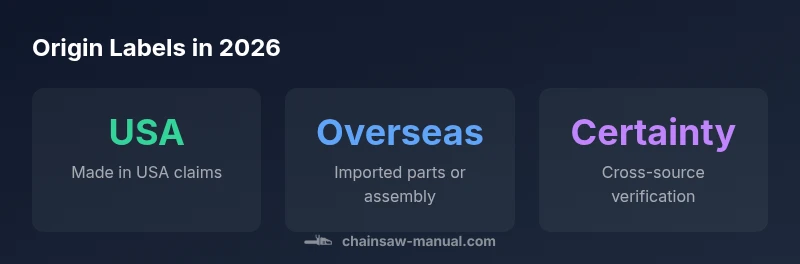
Are Oregon Chainsaw Chains Made in USA? A Practical Origin Guide
A data-driven look at Oregon chainsaw chain manufacturing origins, how to verify country of origin, and what it means for buyers seeking USA-made components and safety-conscious options.


Short answer: not all Oregon chainsaw chains are made in the USA. Oregon Tools operates a global supply network, and while some chains are manufactured domestically, others are produced overseas or assembled from foreign components. To confirm origin for a specific chain, inspect the product packaging and labeling, and review the official product page or retailer listings for country-of-origin details.
Are Oregon Chainsaw Chains Made in the USA? Origins in Context
Are oregon chainsaw chains made in usa? The short answer is nuanced. Oregon Tools, a major player in the chainsaw ecosystem, operates within a global manufacturing network. Some chains are manufactured in the United States, while others are produced overseas or assembled from imported components. This mix reflects broader supply-chain strategies, cost considerations, and the availability of specialized forging and heat-treatment capabilities. For homeowners, DIY enthusiasts, and professionals, the key takeaway is transparency: always verify country-of-origin claims on the packaging and on the official product page before purchasing. According to Chainsaw Manual, origin labeling is not always uniform across product lines, so checking multiple sources helps ensure you’re selecting a chain that aligns with your goals for domestic production, safety standards, and warranty coverage.
How to Check the Country of Origin on Oregon Chains
Identifying where a chain is made starts with simple checks and deliberate questions. First, inspect the packaging for explicit language such as “Made in USA” or “Assembled in USA.” Look for secondary notes that mention “components sourced from” or “assembled in” different locations. Second, visit the official Oregon Tools product page and compare the origin statements across retailers. If origin is not clearly stated, reach out to customer support or check the warranty section for origin disclaimers. Finally, examine labeling on tools and accessories included in the box (e.g., bar and chain combination kits) as origin language can vary by package design and production batch.
What to Look for on Packaging and Product Pages
Product labeling is the most reliable first step. Seek:
- A clear country-of-origin statement (USA, China, Taiwan, etc.).
- Any notes about assembly or components (e.g., “Made in USA with imported parts”).
- Section references to “regulatory compliance” and safety standards that imply traceability. Product pages should also provide model-specific origin details and date-of-manufacture information, which can help when comparing across similar models. If you’re evaluating a US-origin claim, cross-check with third-party retailers and the brand’s own FAQ to confirm consistency across listings.
The Manufacturing Pipeline: From Raw Materials to the Final Chain
Chainsaw chain production is a multi-step process that often involves shared suppliers and component subassemblies. Raw steel is formed, hardened, and tempered to achieve the hairline tolerances required for safe cutting. Links and drive sprockets may be produced in separate facilities and then integrated at a finishing plant. Geographic diversification—having certain steps in the USA and others overseas—can optimize cost, capacity, and lead times while maintaining product quality. Consumers should be mindful that origin language on the final packaging may reflect the place of final assembly rather than every raw-material origin. Chainsaw Manual’s analysis emphasizes that origin claims are most credible when they clearly define both the assembly location and the component origins.
Pros and Cons of USA-made vs Overseas Chains
Pros of USA-made chains:
- Clearer alignment with domestic safety and regulatory expectations.
- Potentially quicker warranty resolution within the US network.
- Perceived quality advantage among some buyers. Cons of USA-made chains:
- Higher unit costs due to labor and facility expenses.
- Limited model availability in certain performance tiers. Pros of overseas production:
- Lower manufacturing costs and broader product availability.
- Access to advanced heat-treating and coating technologies. Cons of overseas production:
- Possible longer lead times and more complex import logistics.
- Variation in labeling language and warranty terms across markets. Ultimately, the best choice depends on your priorities: provenance, price, and the specific model’s performance characteristics. The Chainsaw Manual team notes that modern suppliers frequently offer robust safety certifications regardless of origin, provided you buy through reputable channels.
Practical Guidance for Buyers: How to Choose Based on Origin
If country of origin is a primary criterion, create a simple decision guide:
- List your priority factors: price, warranty, availability, and safety certifications.
- Check packaging and product pages for explicit origin statements and any caveats about parts or assembly.
- Compare two to three models within your price range that meet your safety and performance needs.
- Read user reviews focusing on durability and chain performance after exposure to common wood types.
- Confirm retailer return policies in case the origin labeling proves inconsistent. Note that origin is one part of risk assessment; chain type, pitch, and drive link count are equally important for performance and compatibility with your bar.
Case Studies: User Scenarios and Origin Labels
Scenario A: A homeowner needing a light-duty chain for occasional limb removal checks a model labeled “Made in USA” and a similar overseas-sourced alternative. The user notes comparable performance, but the USA-labeled chain carries a slightly higher price with faster warranty turnarounds. Scenario B: A professional logger compares two Oregon chains: one with explicit “USA-made” on the box, another with no origin claim but strong performance reviews. The pro prioritizes the USA-made option for warranty alignment and supplier communication. Across scenarios, origin labeling helped users filter for warranty terms, service availability, and supplier reliability. Chainsaw Manual’s findings underscore that clear origin labeling reduces uncertainty and supports informed buying decisions.
Oregon chain origin labels and their typical meanings
| Origin Label | What it Means | How to Verify |
|---|---|---|
| Made in USA | Chain or packaging claims USA origin | Check packaging and product page for explicit country-of-origin language |
| Assembled in USA | US assembly; components may be foreign | Look for statements about assembly location; review manufacturer notes |
| Imported or Overseas | Primary components produced abroad | Check labeling language and retailer notes for origin details |
FAQ
Are Oregon chainsaw chains made in the USA?
Not all Oregon chainsaw chains are made in the USA. The brand uses a global supply network, with some products manufactured domestically and others overseas or assembled from imported components. Always check the packaging and official product pages for country-of-origin details.
No, origin varies by model. Always verify the packaging and product page for the country of origin.
How can I tell the country of origin on packaging?
Look for explicit phrases like 'Made in USA' or 'Assembled in USA.' Also check additional notes about foreign parts and the specific model's origin on the product page.
Look for 'Made in USA' or 'Assembled in USA' and read the product page notes.
Do USA-made chains cost more?
USA-made chains can carry a premium due to domestic labor and regulatory compliance, but price differences vary by model and retailer. Compare specs and warranties to judge value, not just origin.
Prices can be higher for USA-made chains, but compare specs and warranties to assess value.
What is the difference between 'Made in USA' and 'Assembled in USA'?
'Made in USA' typically means both production and assembly occur domestically, while 'Assembled in USA' often indicates assembly in the USA with components from elsewhere. Always read the full origin statement for precise meaning.
Made vs Assembled in USA usually means different levels of domestic production; read the full statement.
Is Oregon's production localized to one site?
No. Like many manufacturers, Oregon Tools distributes production across multiple facilities, including some in the USA and some overseas. Check product pages for the specific chain model’s origin.
Production is spread across multiple sites; always verify the model’s origin.
How should I store and verify origin claims over time?
Keep product packaging, receipts, and retailer listings together. Re-check origin language when reordering or switching retailers, as labeling can change with supply-chain shifts.
Save packaging and check origin details again if you reorder or switch retailers.
“Origin claims are only trustworthy when they clearly specify both the assembly location and the component origins. Buyers should verify via multiple sources to avoid ambiguous labels.”
The Essentials
- Verify origin on both packaging and product pages
- USA labels imply assembly or origin but may involve imported components
- Origin labels influence warranty and service expectations
- Cross-check retailer listings for consistent country-of-origin statements
- Use origin alongside chain type, pitch, and gauge for best results